Star Trek Novel Reviews: The Entophy Effect | Yesterday's Son
OUR PHASERS SET TO STUN CREW HAS SOME READING SUGGESTIONS FOR WHEN YOU'RE AWAY FROM THE BRIDGE
Over the last fifty years, Star Trek has brought us hundreds of novels and novellas,
representing one of the largest and most enduring tie-in fiction programs in publishing
history. Through its pages, generations of readers have reached beyond the movies and
television series to explore deeper themes, unseen missions, and complex character
developments that have kept the spirit of Star Trek alive. The Pocket Books line of Star
Trek novels represents one of the longest-running and most influential licensed literary
series in science fiction publishing.
Beginning in 1979 with the release of the novelization of Star Trek: The Motion Picture, the imprint became the primary publisher of original Star Trek fiction for over four decades. This expansive line grew toencompass every major era of the franchise, including Star Trek: The Original Series, Star Trek: The Next Generation, Star Trek: Deep Space Nine, Star Trek: Voyager, Star Trek: Enterprise, and a range of crossover and standalone stories.
Your core Trek crew here at “A Film By” seek to bring you an in-depth look at these
many stories told out-side the usual continuity. In this on-going series, we will look at the
many Star trek novels that have been offered over the years, and those yet to come.
We’ll warp to you reviews of the best and the worst Trek has to offer, and let you know
which ones to beam into your hands, and which ones you’ll need to set your phaser to
disintegrate. We’ll give you a descriptive synopsis every time, some may even pique
your interest, and then break it down with a detailed and honest review to help you
choose. We’ll even throw in a few interesting facts and some behind-the-prose
information for fun!
We continue with two more novel entries from the earliest years of the range, both with
a time-travel element…
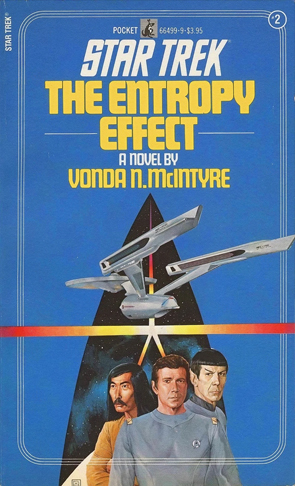
STAR TREK NOVEL #2 – THE ENTOPHY EFFECT by Vonda N. McIntyre
Published in June 1981 by Pocket Books. ISBN # 0-671-83692-7
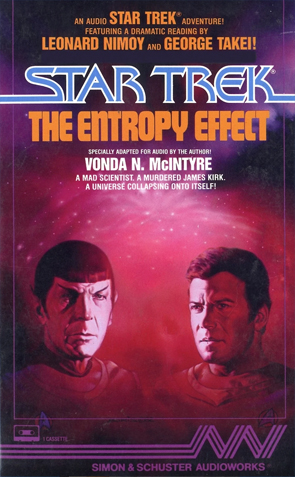
“The Enterprise crew discovers that a brilliant scientist, Dr. Georges Mordreaux, has
mastered time travel and is using it to commit a series of murders across history. These
killings create temporal disturbances that threaten the stability of the entire timeline,
drawing Kirk, Spock, and McCoy into a desperate pursuit. As they chase Mordreaux
through different eras, the crew struggles with the moral implications of interfering in
history. They uncover Mordreaux’s tragic motivations, rooted in a desire to control fate
and prevent perceived chaos in the universe. The pursuit forces the crew to confront the
limits of their own understanding of time and causality. Ultimately, they must find a way
to stop Mordreaux without causing irreparable damage to the continuum, highlighting
the perilous consequences of tampering with time.”
The Entropy Effect, written by Vonda N. McIntyre, stands out as one of the earliest
original Star Trek novels to delve deeply into the difficulties of time travel and its ethical
implications. The story centers on Dr. Georges Mordreaux, a brilliant scientist who
discovers the ability to travel through time and uses it to commit a series of murders
with far-reaching consequences. McIntyre’s story is tightly constructed, balancing the
suspense of a murder mystery with the challenges of temporal physics. The novel
excels in portraying the Enterprise crew, particularly Captain Kirk, Mr. Spock, and Dr.
McCoy, in ways that feel true to their on-screen counterparts, giving us action, intellect,
and moral reflection that are true to characters from The Original Series. The pacing is
perfect, allowing the reader to absorb the tension of a timeline in jeopardy while
exploring the philosophical questions about destiny, free will, and the ethics of
interfering in time.
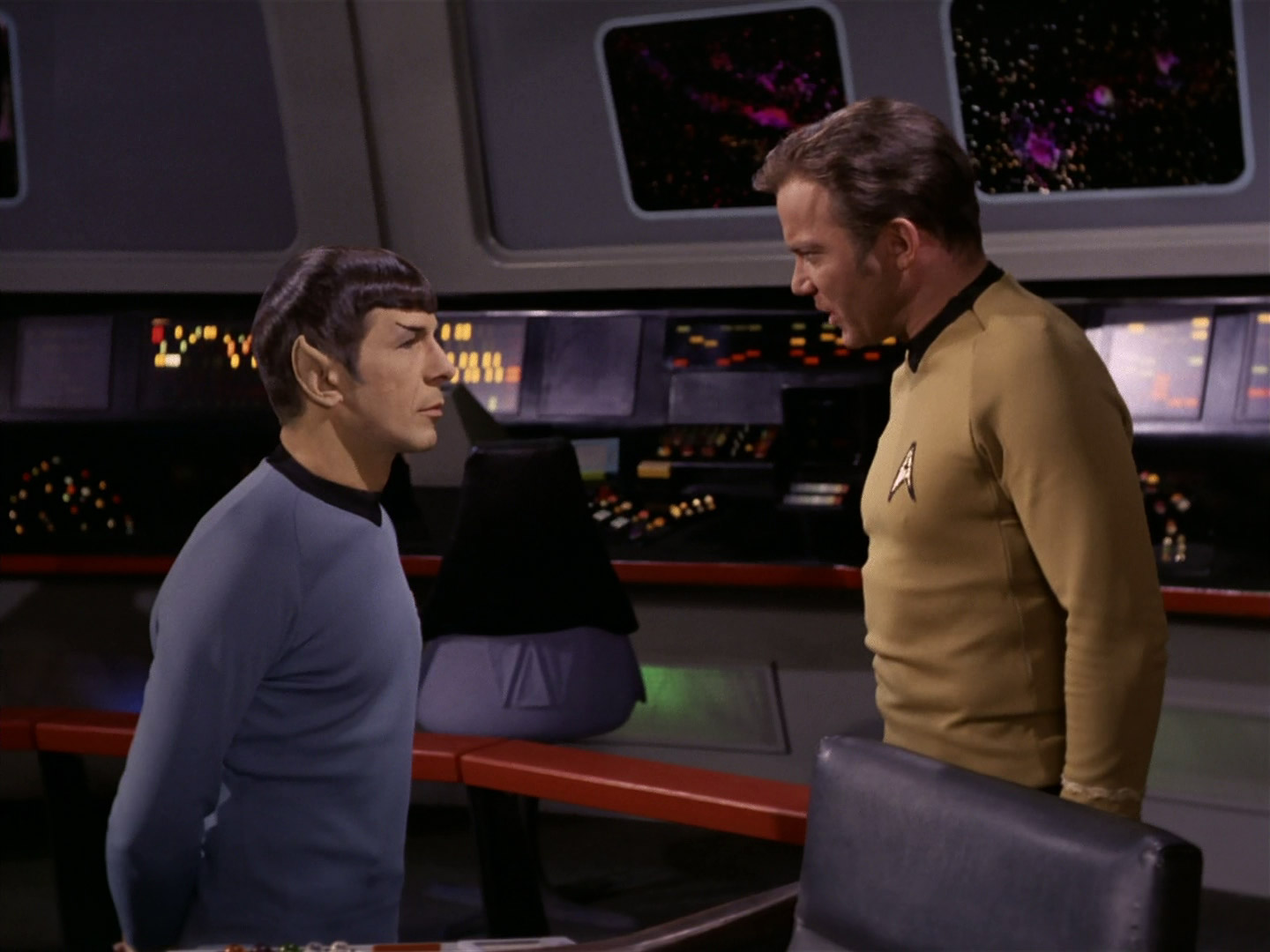
One of the novel’s strongest attributes is its character-driven approach. McIntyre gives
depth to both the heroes and their opponent. Dr. Mordreaux is not a stereotypical Star
Trek villain but a figure motivated by his desire to create order in the chaotic universe.
The Enterprise crew’s interactions reflect genuine friendship and mutual engagement,
particularly in the scenes where Spock’s logic clashes with Kirk’s intuition, and McCoy’s
ethics provide a moral counterpoint between the two. This attention to characterization
shines in The Entropy Effect above many of the other novels published around this time,
which often focused primarily on plot and spectacle. The dialogue is sharp, the
characterizations familiar, and the novel successfully captures the spirit of Gene
Roddenberry’s original vision while expanding on it in new and challenging ways.
However, the book is not without its problems. Some readers may find the science of
time travel and its consequences dense and hard to follow, requiring close attention to
understand the cause-and-effect of Mordreaux’s actions. Additionally, the novel’s
ending, while satisfying, relies on a final confrontation that feels somewhat rushed
compared to the buildup. Nevertheless, these issues are minor in my opinion. The
Entropy Effect remains a compelling and intellectually engaging Star Trek novel, notable
for its early exploration of temporal ideas and ethics, its well-written characters, and its
suspenseful, morally complex narrative. For fans of both Star Trek and science fiction in
general, it is a fantastic read that stands the test of time.
BOOK FACTS:
- This is the first Star Trek book published by Pocket Books after their adaption of
Star Trek: The Motion Picture, and the first in a long line of original Star Trek
novels. - This novel contains the first time that both Hikaru Sulu and Nyota Uhura’s first
names are mentioned. Sulu’s first name wouldn’t be spoken on-screen until Star
Trek VI: The Undiscovered Country over 10 years later. Sulu also receives his
promotion to lieutenant commander here, a rank he holds when he appears in
Star Trek: The Motion Picture. Uhura had to wait much longer for her first name
to be spoken on screen, first being heard in the 2009 J.J. Abrams Star Trek film. - While the cover of this novel shows the characters wearing the Star Trek: The
Motion Picture-era uniforms, the novel actually takes place earlier during the
Enterprise’s original five-year mission. The stardate mentioned in the novel would
place it just before the events of The Animated Series episode “The Infinite
Vulcan”. - The novel was one of four novels to be re-released in late 2006 in time for Star
Trek's 40th anniversary, along with Vulcan’s Glory, Federation, and Strangers
from the Sky. - An audiobook version of the novel was made available through Simon &
Schuster Audioworks in August 1988, featuring a dramatic reading of the story by
Leonard Nimoy and George Takei. The entire subplot with Sulu from the original
novel was dropped from the story in order to allow the story to fit on one 90-
minute cassette tape. A different cover was used for the audiobook release,
taken from the cover of the novel Triangle.
A Film By rating: Three out of Five Phasers.
STAR TREK NOVEL #11 – YESTERDAY’S SON by A. C. Crispin
Published in August 1983 by Pocket Books. ISBN # 0-671-47315-8
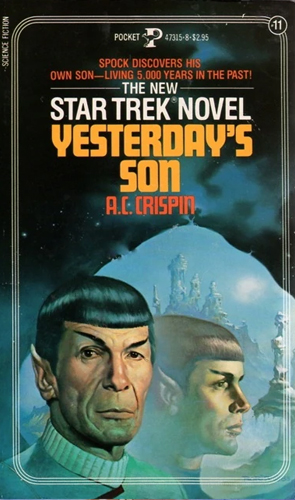
“Spock discovers through an archaeological photograph that he has a son living in the
distant past on the planet Sarpeidon. The child, Zar, is the result of Spock’s brief
encounter with Zarabeth during the events of the original series episode “All Our
Yesterdays.” Realizing that Zar is stranded in a primitive, hostile era, Spock persuades
Captain Kirk and the Enterprise crew to mount a dangerous time-travel mission to
rescue him. Upon arriving, they find Zar grown into a proud but isolated young man, torn
between his Vulcan heritage and his harsh human environment. Bringing Zar into the
23rd century creates new challenges, as he struggles to adjust to Vulcan society and
his father’s expectations. Ultimately, Spock and Zar must come to terms with their bond
across time, learning mutual respect and understanding while preventing another
temporal catastrophe.”
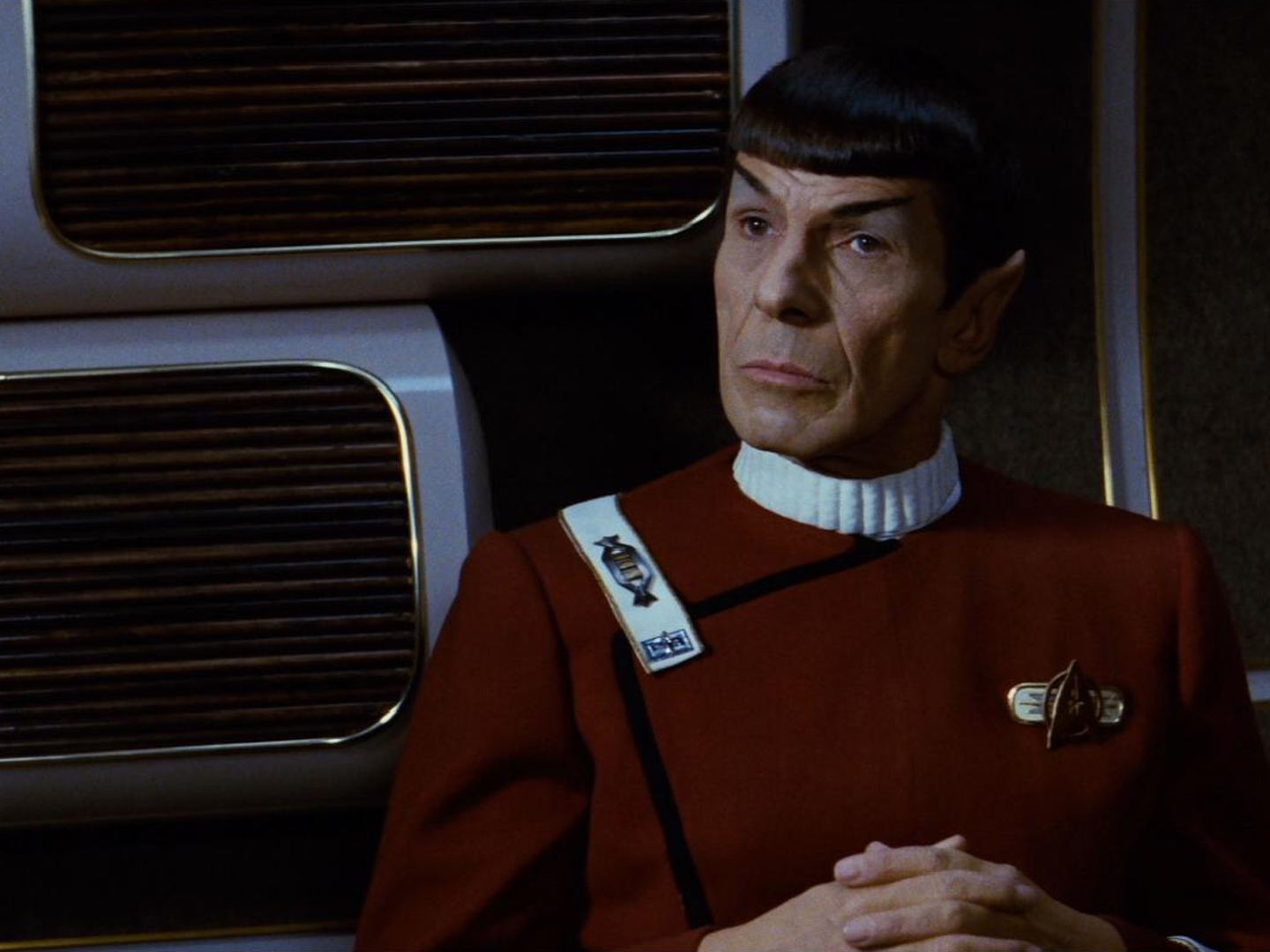
Yesterday’s Son is a thoughtful and interesting sequel to one of Star Trek’s most
haunting Original Series episodes, “All Our Yesterdays.” The novel begins when Spock
discovers an archaeological image suggesting that his past encounter with Zarabeth in
the planet Sarpeidon’s Ice Age left behind more than memories… he fathered a son
named Zar! This revelation sets in motion a provoking time-travel adventure as Spock
convinces Captain Kirk and the Enterprise crew to return to Sarpeidon to rescue the
boy. Crispin’s storytelling blends hard science fiction concepts with powerful emotional
stakes, capturing the wonder and danger of temporal exploration while deepening
Spock’s personal background and mythology. The novel’s setup is both logical and
moving, transforming a often forgotten television episode into a emotional story about
loss, legacy, and the consequences of time.
Ann C. Crispin is no stranger to franchise novelizations, having written books for Star
trek, Star Wars, the Alien movie series, and even an adaption of the TV mini-series V.
Crispin excels in character work, particularly in her portrayal of Spock’s internal conflict
between duty, logic, and emotion. His attempts to rescue and then relate to Zar feel
authentic, revealing a paternal instinct and vulnerability rarely explored in Spock’s on-
screen appearances. Zar himself is a fascinating creation, part Vulcan, part human, but
raised in an rough prehistoric world that has taught him to be a survivor. His resentment
toward Spock at the beginning and his confusion about Vulcan culture provide the novel
with a lot of base emotion. Meanwhile, Kirk and McCoy’s supporting roles add warmth
and perspective, as they react to Spock’s personal struggle with compassion and humor
that ring true to their long friendship. The novel neatly balances self-examination with
adventure, featuring moments of suspense and action that make it hard to put down the
book until the last page.
By the end, Yesterday’s Son succeeds brilliantly not only as a science fiction
adventure but also as an exploration of identity, family, and reconciliation. Crispin’s
writing demonstrates a deep understanding of what makes Star Trek so popular, how
intellect, emotion, and morality intersect in the pursuit of understanding oneself and
others. The ending of the story, which doesn’t end on a happy note, is both satisfying
and mature, establishing both Spock’s humanity and his Vulcan discipline. It also
expands the emotional universe of Star Trek by showing the lasting effects of actions
taken in a single episode and their effect across generations. For all the Spock fans and
those who appreciate a well-written Star Trek story, Yesterday’s Son remains one of the
standout novels in the franchise’s literary canon.
BOOK FACTS:
- This is the first Star Trek novel for author Ann C. Crispin. She would go on to
write five further Star Trek novels, including a sequel to Yesterday’s Son titled
Time for Yesterday in 1988. - A.C. Crispin also wrote novels for other franchises as well. Some of her other
well-known work includes Star Wars: The Han Solo Trilogy series, which includes
the novels The Paradise Snare, The Hutt Gambit, and Rebel Dawn, all published
in 1997, three works based on the television series V, including an adaption of
the 1982 mini-series, as well as the novel adaptions of the films Alien:
Resurrection and Pirates of the Caribbean: The Price of Freedom. - This is the first original Star Trek novel to make it onto the New York Times
Bestseller list. Before this only the novelizations of the films Star Trek: The
Motion Picture and Star Trek II: The Wrath of Khan made it to the list. - An audiobook version of the novel was made available through Simon &
Schuster Audioworks in August 1988, featuring a dramatic reading of the story by
Leonard Nimoy and James Doohan.
A Film By rating: Four out of Five Phasers.
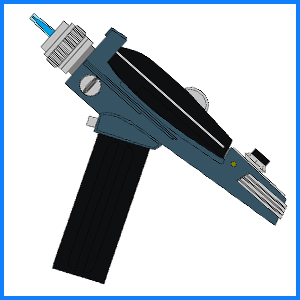
The “A Film By” Phaser Rating Scale
Five Phasers – One of the best Star Trek novels, beam it up immediately!
Four Phasers – An excellent adventure, worthy to seek out and discover.
Three Phasers – Not a bad one, will keep you entertained during the long shuttlecraft rides.
Two Phasers – It’s okay, but I wouldn’t warp out of my way for it.
One Phaser – Shield up! Go watch “Spock’s Brain” instead.

Co-Host
Wayne Whited is a Co-Host on the A Film By... podcast. His expertise on Star Trek has been highly beneficial on our Star Trek-themed series "Phasers Set To Stun," which he co-hosts. He is a writer and Executive Producer for Historical Productions Inc. and has an endearing interest in comic conventions; a passion he recently renewed and shares with several team members. Wayne lists "The Black Hole," "E.T.," and "The Empire Strikes Back" among his favorite films, but is quick to remind us that his preference is television. He counts "Star Trek," "Amazing Stories," and "Doctor Who" as personal favorites. Wayne's favorite director is Steven Spielberg.
Star Trek Novel Reviews: Star Trek: The Motion Picture - A Novel | Web of the Romulans