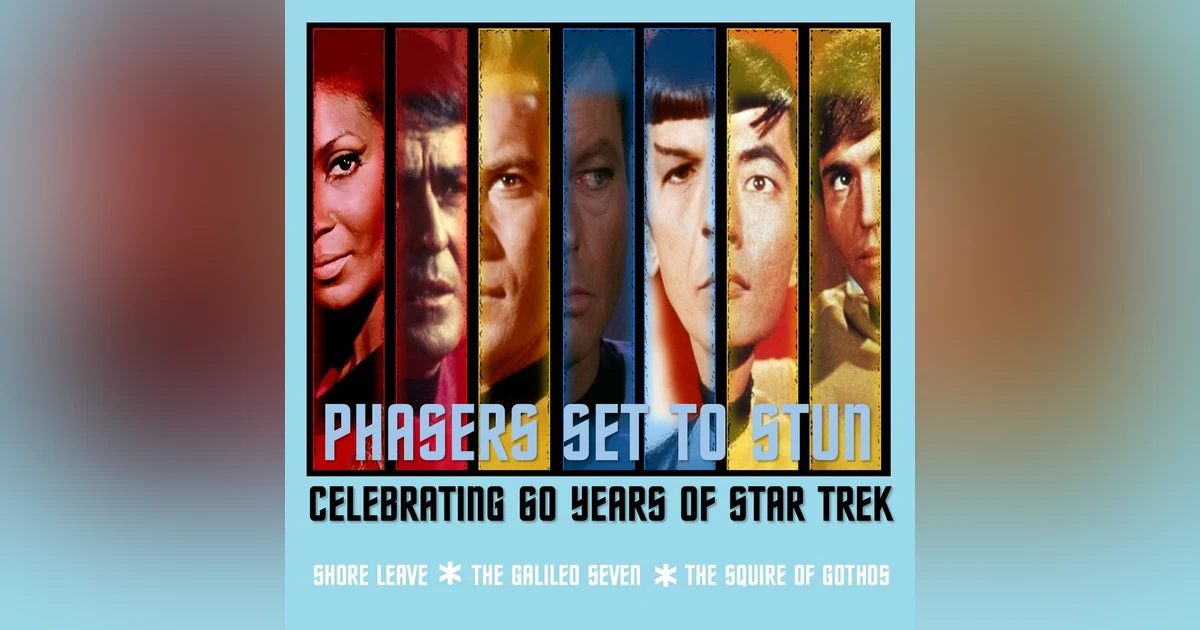
Phasers Set To Stun: Star Trek TOS |Shore Leave | The Galileo Seven | The Squire of Gothos

 Apple Podcasts

 Spotify

 Goodpods

 Pandora

 Amazon Music

 iHeartRadio

 Castbox

 Deezer

 TuneIn

 Podcast Addict

 Podchaser

 Spreaker

 JioSaavn

 Castro

 RSS Feed
On Phasers Set To Stun, we recognize the popularity of all things Star Trek, with a look at the television shows, animation, movies, and much more!
Wayne and Scott warp through several of the original series' more unusual episodes this week with their in-depth analysis of Shore Leave, The Galileo Seven, and The Squire of Gothos!
Watch us on our YouTube Channel and subscribe now!
Head over to our Patreon and get started with a FREE 7-day trial. We've got plenty of exclusive content and episodes that you'll only find there! You can also sign up as a free member!
Wayne's Star Trek book reviews can be found here!
Write to us at A Film By... Podcast with your questions, and comments about the show. You can find our full library of content, access to our social media, and links to all of your favorite streaming platforms!
0:01 Space, the final frontier. Join us for a bold conversation. Our prime directive, to recap our favorite Star Trek shows, both new and old. To engage in debate about all things Trek. Prepare to energize. with phasers set to stun.
0:43 I have a question, sir. Yes, Data, what is it? What is death? Oh, is that all? Well, Data, you're asking... probably the most difficult of all questions. Some see it as changing into an indestructible form, forever unchanging. They believe that the purpose of the entire universe is to then maintain that form in an earth-like garden, which will give delight and pleasure through all eternity. On the other hand, there are those who hold to the idea of our blinking into nothingness. with all of our experiences and hopes and dreams really a delusion.
1:36 Which do you believe, sir? The uncertainty, the self-discovery, the unknown. These are many of the qualities that make life worth living. Well, at least to me. It is possible to commit no mistakes and still lose. That is not a weakness. That is life. I wouldn't want to live my life knowing that my future was written. My boundaries had been already set. The challenge, Mr. Offenhouse, is to improve yourself. To enrich yourself. A person's life, their future hinges on each of a thousand choices. Living is making choices.
2:26 Live now. Make now. Always the most precious time. Now will never come again. That may be impossible, sir. Things are only impossible until they're not. Yes, sir. There is a way out of every box, a solution to every puzzle. It's just a matter of finding it. Sometimes you just have to bow to the absurd. Which do you believe, sir? Considering the marvelous complexity of the universe, its clockwork perfection, its balances of this against that, matter, energy, gravitation, time, dimension.
3:11 I believe that our existence must be more than either of these philosophies, that what we are goes beyond Euclidean or other practical measuring systems, and that our existence is part of a reality beyond what we understand now as reality. Captain Picard, eh? I'm, uh.... I'm a role model.
4:07 Hello, everyone, and welcome back to Phasers Set to Stun, where we continue to show our love for everything Star Trek in this ongoing series from a film by podcast that explores the expanding Trek universe by covering television, animation, movies, directors, merchandise, and so much more. Plotting the course, as always, is your core Trek crew. I'm Scott Hoffman. And I'm Wayne Whited. Once again, we're heading back to the original Star Trek, which continues to celebrate its 60th anniversary this year, which is still hard to believe every time I say it. It's a great way to get ready for new shows like Starfleet Academy and Strange New Worlds by focusing on refreshing our perspectives on those classic series that continue to inspire us six decades later. Along those lines, we wanted to dedicate this episode, the first one we're recording, since we lost two pivotal crew members, Walter Candid and Sir Patrick Stewart. These were devastating losses for the first two generations of the franchise, and their influence continues to shape the future of Trek as it moves forward. I still find it hard to believe.
5:08 I do too. It's, I can't, even with like two weeks now, I can't get my mind around it. I mean, you know, I just recently met Walter Koenig and got my picture with him. And, and, you know, it's, it's hard to think that, you know, most of the original cast are, are gone. There's only two left and it's, I just can't get my mind around it. And Patrick Stewart, I haven't recovered from that, that, that's hurts because he, I'm sorry, Kirk, but he was my captain because that's the show I grew up on and, you know, being just a couple of years after Star Trek, the cards third season, which, you know, now I look back on that and think of, you know, what an incredible dedication.
5:53 And now I see why they made it. Yeah. You know, it's, it's rough. It's really hard dealing with his loss. I know we still get one more, performance from him coming up later this year in Avengers Doomsday. I'm looking forward to that. It's going to be hard. I definitely cried when I heard his loss because that hit me right in the gut. Yeah, I mean, I agree with all of that. I mean, I think Walter Koenig is one where I connected with him probably the most when I first connected with him in Wrath of Khan. being the youngest of the crew members.
6:34 And he had an amazing role in that and so many of the subsequent movies, which is really where, obviously, I've encountered him the most. And, yeah, Sir Patrick Stewart was my captain, and I think always will be. The tremendous gift is that we have his performance that is influencing so many other captains that have followed, that we got a series like Picard, uh, before he passed that we got so many amazing films and episodes with, uh, Walter Koenig's influence, uh, before he had passed. So it's, it's one of those, uh, losses that, uh, doesn't necessarily feel real because all of their performances have immortalized them so much.
7:21 Yeah. And you know, Walter Koenig to, um, hit me hard because, uh, I'm all, He's not just Star Trek, but he was involved in another franchise, Babylon 5. And I am a huge fan of that show and have been since it aired. David actually is the one that hooked me up on that. And we've lost so many cast members from that show. And just every time, it's just devastating. And another one's gone. It's rough for both of the fans of those franchises. And I've seen so many great... tributes pouring in for both Walter and and Patrick I mean they've been absolutely phenomenal that not only his colleagues but the fandom has really came out and provided some beautiful beautiful tributes to both of them and they both are well deserved.
8:13 Absolutely I mean beyond the performances it's their dedication to the franchise to the fans yes the people that they were beyond the screen and the time that they would take to understand how much of an impact they had and the worlds around them that they had helped to create have had on us. And I think through this podcast, I think through every subsequent viewing, every time somebody asks the question, well, who was Walter Koenig? It's a great moment to be able to introduce them. And you and Dave are going to be able to do that with me later when we cover Babylon 5, inevitably, at some point. Probably not as part of this, but I've never watched it.
8:56 I want to, and you will love it. You'll love the show, and you'll love Walter's appearance, his performance. It's so different from Chekhov. He was the ultimate villain. He was the con of that show, and he's just so beautifully evil. He performed it fantastic. Cool. That sounds like a lot of fun. All right. Well, let's get into it with the first three. First of the three episodes we're exploring, Shore Leave. It originally aired on December 29th, 1966, directed by Robert Spahr and written by Theodore Sturgeon and Stephen W. Karabatsos. Wayne, why don't you try to sum this one up?
9:40 After three months of exhausting operations, the Enterprise arrives at a seemingly peaceful planet in the Omicron Delta system, and Captain Kirk authorizes Shore Leave for the crew. However, strange appearances, including a giant white rabbit, Don Juan, and figures from Kirk's past, reveal that the planet can bring people's thoughts and memories to life. When these creations become increasingly dangerous, and the crew's communications with the Enterprise are cut off, Kirk and Spock discover that their own thoughts are responsible for these strange events. They eventually meet the planet's caretaker, who explains that the world is an amusement park, allowing Kirk and his crew to finally enjoy their short leave.
10:20 This was an interesting one. Yeah. Well, it's weird that we chose these, these three episodes. Cause I mean, they aired, they aired together. That's why we chose it, but they're so different. This one's very different from anything else before. Well, I kind of feel like looking at this trifecta, there's a bit of a book ending thing happening here. Like there's, you know, transported to a fantastical planet where anything can happen. And then landing on a different planet that's run by one person that has his own whims and, you know, um, bends in reality um i am curious about this one is this one that you revisit often or one that you usually skip. Uh well i i've revisited so many times that i've gotten sick of it actually it's one of those episodes that they seem to to play over and over again every time i turned star trek on during the 80s and the 90s it happened to be shore leave that was being played i don't know why it just pure coincidence um it's not a bad episode i i actually when i look at it and i've watched it again this first time in probably a decade i enjoyed it but i just remember being not this episode again.
11:26 Yeah yeah because you had it so many times yeah i don't know i mean it was um it didn't really seem to add much to the franchise like no to me i mean i think i've seen Part of it once, which must have been one of those, you know, it's like on heavy rotation, like on TNT when they'd always play Shawshank Redemption like every other day or something like that. I did see that this is one that Gene Roddenberry was frantically kind of reworking the script while it was filming. Yeah, that's what I heard, yeah. And it just seems a little all over the place. It seems like an amusement park kind of planet, but almost like a a haunted house, but you don't know it's a haunted house yet, right? It's like a deadly version of Ryza run by Q or one of the Cenobites from Hellraiser or something like that. This isn't really a planet that comes back in canon, does it?
12:24 It does come back, but only in the animated series. Okay. I mean, it seems like. It works better in the animated series. Right. It does. You're right. You're right. It does have potential, and it could be explored a little bit more now. It's an interesting idea. The whole thing really is an interesting idea. But I just have a love-hate relationship with this episode because it's a fun episode, but it's just weird Star Trek to me. I don't know if that makes any sense. And I feel some of the characterizations are off. I just feel like it took him forever to figure out what's going on.
13:07 I can't believe that it took him that long. And I think that's what bothers me the most about the episode is that. Yeah. Well, and it seems weird to, you know, it's probably just coincidence that you happen to come across it so often. But the fact that you come across it so often means that it gets pretty heavy play. But it doesn't seem like it's really a great representation of Star Trek. Just because it happens to go all over the place and you're not sure what to trust. Right. Yeah. Yeah. And I, I mean, I don't know why it kept getting played so much because it's, it's one of those episodes that's not talked about very much. Not like, not like last episode, balance of terror, which was like really important.
13:48 And it's talked about a lot. This one seems to be kind of ignored. Um, Mostly, like I said, it's only been brought up once. I can't think of any novels or comics or anything that actually explored this episode or continuing it. But I don't know. I wish I would have looked in to see exactly how well received this episode was. I'm actually curious about that because, like I said, it's not a bad episode. I tolerate it. That's the best way to put it. I tolerate this episode. If it's one, I'll watch it. You know, but it's not one of my favorites. Yeah. Well, I mean, along the lines of not quite the favorites, this in this in this trio of episodes, Bones really bothers me. Yeah. And I feel like in this episode, his infatuation with Yeoman Barrows just feels oddly timed and a little creepy.
14:49 Yeah, it does. Yeah. You know, I know that it's a product of the time when there would be, you know, well, if there's a female character, then there has to be some kind of, you know, romantic kind of angle to it or something like that. But it just seems like, what are you doing? Like in the middle of all this danger for him to have that approach to the yeoman and the fact that she's essentially sexually assaulted by a, manifestation of Don Juan it was just like this seems not right. And I think that's a product of the rewrites because if I believe if I read somewhere that that yeoman was actually supposed to be Janice Rand and it was supposed to involve Kirk rather than McCoy and the rewrites were brought in and Kirk's old flame was brought in and it was all I wish I'd like to see the original script I'd like to see if it was actually an improvement I don't know if that's available but one thing I do want to state out is I absolutely hate the character of.
15:46 Fennigan Thank you. He is the most annoying character in the original series, I think. I wanted so much for Kirk to punch him, but it took forever for it to happen. It was so annoying. Yeah. I mean, that's an appropriate word to use because he reminded me of the Noid from the Domino's commercials. Take that essential character, break him down into the villain for a monkeys episode. Um, from way back in the day, just like the, the hyper fast forward and the bouncing all around taunting is just, yeah, I think the planet could probably benefit from a better caretaker. Um, because I mean, with that kind of planet, whatever is happening that helps people like, you know, manifest their thoughts into something. Um, it feels like it could be a West world kind of planet, right? If you've got a bunch of people that want to do like intellectual scientific pursuits, um, Yeah, think of the possibilities.
16:46 The whole possibilities that could be done. But what happens? Kirk thinks about someone who he hates in the academy. Come on now, Kirk. You've got a better imagination than that. Right, yeah. I mean, my problem is I'd probably be stuck at work the entire time. Because I wouldn't be able to stop thinking about work and I'd be like, why am I here? But, no. It's an interesting episode for sure. It is, yeah. It's got nothing to do with continuity, so It is an episode that can be skipped, but it's not totally terrible. I think it's skip possible, but not necessarily skip necessary. Right. Good. Yeah. But anyway. Well, with that being said, let's go ahead and take a quick break after that one. And when we come back, we'll get into the next episode, which I like a lot better. Okay, listeners, welcome back.
17:40 We're continuing that run through the original Star Trek. Up next is my favorite of the three, The Galileo 7. This one first aired on January 5th, 1967. It's directed by Robert Gist and written by Oliver Crawford, Shimon Wenzelberg, and Stephen W. Karabatsos. Wayne, why don't you take the helm and flash through the synopsis of this next one. While en route to deliver medical supplies to Makus III, the Enterprise investigates the mysterious Murasaki 312 formation, sending Spock and a science crew aboard the shuttlecraft Galileo. Forced to crash land on the hostile planet Taurus II, the crew encounters enormous primitive creatures that begin attacking them, resulting in the death of two team members. As Scott struggles to repair the shuttle and tensions rise among the survivors... Spock must find a way to escape before the creatures overwhelm them with the Galileo unable to reach orbit. Spock uses the remaining fuel to create a massive flare that alerts the enterprise, allowing Kirk to rescue the survivors just before the shuttle is destroyed.
18:49 So this one, I think does have a lot of replay to it. And I think it does have a lot of significance in terms of, you know, if you're curating kind of a original series sampler, I would probably pick this one. Um, it has the right blend of, um, kind of drama and peril. The, um, the interpersonal relationships in this one are interesting, um, even though they bother me. And, um, it's the, the right amount of kind of fantastical weird with the, uh, the, the giants, um, who, you know, have these cartoonishly enormous spears that just seem like horribly ineffective weapons. But anyway, um, What are your thoughts on this one? Is this one that you would come back to?
19:35 Yeah, I agree with you. This is probably my favorite of the three. I wouldn't exactly say it's one of my absolute favorites of the first season, but it's definitely on the top. It's just I like the fact that they're doing something different here than your your usual, you know, Enterprise adventure with crew with Kirk and all them on the bridge. Here we get Spock. He's got the command. He's got, you know, the struggle with trying to figure out what's going on. And you got the landing party with the shuttle. You know, they're there. have all this stuff they have to deal with. They've got the aliens on the planet, which are kind of weird too, but it works. It's a straightforward survival story. I like that.
20:18 I just like how it, and I like Spock's fighting his logic and coming up with a solution. They all come up with a solution and the rescue. I think it's wonderful. Plus, you know, I love the shuttle. I always have. I love Star Trek shuttles, and here we have an entire episode about it. with it, you know? Um, so yeah, this, this definitely is, is my, one of my favorites. I would probably play places in my top 10 for first season episode. Yeah. I mean, it's got a lot of, you know, classic tropes that I recognize. Um, but I think, I feel like there's a good representation of them, you know, um, trapped on a planet in a shuttle. Um, everybody having their own kind of tasks or missions that they have to kind of focus on, um, and, uh, a challenging, um, first command. Now, two people die, but that happens under any command. I think Spock does a good job here, especially considering what kind of struggles he's having in this situation.
21:19 I mean, he seems like he's starting to doubt his own approach, his own logic, and he seems to be surrounded by doubt from the rest of the crew, almost except for Mr. Scott. Is that fair? No, that's fair, yes. It just really bothered me how much the crew was kind of treating Spock unfairly, like throwing the logic into his face. And I don't know, a bit racist and subordinate. It is, but they were also under pressure. So I'll give that. There is one thing that bothers me with this episode. Not enough to spoil my enjoyment of it, but I've always thought of this. And Kirk, what is he doing? What is wrong with him? Why did he make this decision? They are on a mission to go to this planet. That's why they got that commissioner there to deal with. Is it a phantom or something? I can't say the word now. Yeah, that's it. But it's an extremely important mission. And lives are on the line.
22:23 Yet he says, oh, well, you know, we have to go explore this nebula because that's our mission. Can't that wait? Why are you diverting from a very important mission to go do some scientific research on this nebula thing? And then, you know, if Kirk would have just stuck to his original mission, none of this would have happened. And those crew members. Wouldn't have died. So, Spock, you did a great job. Kirk, what's going on in there? What's wrong with you? No, that's something I had never thought of until now. It's almost like, you know, the entire episode didn't need to happen. If it was exploring the nebula... they could have launched a buoy.
23:06 Yeah, they could have come back to it later. Exactly. And then taking their time, I don't know. But I know that's like, where's the drama? But still, that's a great point. Because the commissioner does kind of wear on us a bit, even though he definitely has a point, but he's made to be that person that just annoys you and you don't want to see him succeed. Right. I mean, I understand Kirk's reasoning for wanting him not doing anything, wanting to save his crew members on the planet. But they didn't need to be put in danger in the first place. You know, Kirk, it's your fault. That's true. That's true. Do we ever see this species of giants come back? No, I don't think so. I can't think of any instance, none on TV. And I can't think of any books or comics or anything where they did. I think they've been pretty much ignored.
23:56 It was an interesting choice to not show them ever. but it was always that kind of audible threat. Well, for 1960s television, that was probably a good idea. Oh yeah, for sure. Well, and there were a couple of times when you saw the spears being tossed. I thought one, like, uh, there's a scene where Spock has a crew member over his shoulder and he's running away. And it looked like the, the spear like bounced off the guy's head. It was over his shoulder. And I was like, that seems like a bad, bad idea. But, um, I thought it was a very, you know, kind of taps into primal instincts, you know, to just have the audio playing there. I thought it was great atmosphere. It was just shy of them going into a cave with all that kind of, you know, rocky atmosphere and things like that. But, yeah, I don't know. I think he got an unfair shake. I think one of my favorite parts of it is when they are, um, when they're finally in orbit, when they're finally able to take off and it's got a decaying orbit. Um, I thought that was a great, uh, structure of tension in that one. Um, it had, it had me on the edge of my seat the entire time. And, um, I thought his idea of igniting the fuel, um, was a great solution. Um,
25:26 But would you agree? Do you think it was more desperation or was it inspiration? Oh, it's desperation, yeah. And I agree. I love the ending to this episode. I think it's great. It's a great Spock episode. I think that's why I enjoy it more than I should. Spock gets the spotlight in this. He's got the crew. He's fighting against them and trying to figure out a... means of getting out. And I really like the last scene that they have in there with him and Kirk, where Kirk tells him that he has to admit that emotion had to play part in the decision, but no, he says it was a stubbornness.
26:08 I like that. It was a nice little ending to a really good episode, an episode I enjoyed. So the effects that I'm seeing today as a first-timer seem like they're I guess I'm specifically thinking of the ship, the space shots where you can see the entire shuttle or you can see the ship. How do the effects today, I guess with the modern restoration, compare to what we were seeing back then in the original 60s? Well, this was a very effect-heavy episode and it kind of showed... I don't think they were able to, the effects aren't bad, but they weren't able to pull off exactly what they wanted to do just because they didn't have the budget for it. This is one of those cases where I think the, the, the special editions, the, the remastering versions with the new visual effects really works because there's a lot of them in here. They redid all the visual effects. And I think this is one of the heaviest that they did. There's more redone visual effects in this episode than any of the other ones.
27:13 And it, I really do prefer the remastered versions. It shows better what they originally intended than what they were able to do back in the 60s. Yeah. Well, and I think it still has the... I think it does a nice job of having a balance of maintaining the original aesthetic and the original kind of appeal. It's not trying to modernize it so much that it's polishing all of it. It's kind of like if Disney... You know, when Disney redoes like Pirates of the Caribbean or Haunted Mansion, right? They're not trespassing on that original aesthetic that works so well that people still want to see, but they're just making minor improvements to make sure that it still holds up.
28:00 Right. It doesn't seem like they touch too much of what's happening on the planet, but especially when Spock ignites the fuel. it seemed like a really good treatment. It seemed like good effects, but it didn't seem like it was modernized. Like it didn't seem like. Something that would be. Yeah. The original effects were rather underwhelming, um, but it was the best that they could do with the money that they had. Um, so yeah, the new visual effects are, are much better and really show, give, give you more of a sense of what's going on and what the original writer had intended. So it's, it's worth watching to remember. Yeah. I also appreciated the, um, the growth that we see with Spock and his leadership, like there's a very specific scene where you can see Spock doubting himself out loud.
28:47 Yeah. And it could go in a direction where it seemed like it's somebody who's going to give up on leadership or completely doubt he can be a leader. I think this helps to show what kind of leader Spock can be. or what kind of leader he is. I think it's an opportunity for him to kind of see some of the places where he has to reconcile that doubt. But I really respected his resolve on the planet with all of his decisions. I mean, he was taking input from the rest of the crew, but he was convinced that he was convinced that he was right. Yeah. I mean, his logic, he was fighting against his own, you know, his own self because, you know, he, He's such a logical person. He wants to be full Vulcan.
29:37 He's not, but he has to realize in this episode, and I think the others with him led him to understand that just logic alone is not going to be enough to save them. He has to go past that. He has to rely on the other people. He has to think beyond just the logical just to save everyone. And that's why it makes such a great Spock episode this early on, especially. Yeah, absolutely. Well, and it had that great early tension where there is the decision about who should be left behind. I don't know. It was such a great blend. Like this is one that I can see coming back to and just having on in the background. Yeah. It's that kind of episode that just, I don't know.
30:17 It's very easy to follow. So it's interesting that this is kind of sandwiched between two reality bending episodes. Like this is a very like grounded as much as, you know, science fiction can be, but a very grounded episode that I think is a great follow-up, I would say, to Balance of Terror. It's almost kind of like you have in every other, right? Yeah. All right, well, let's take one more break before we get into the weirdness of the third episode. All right, listeners, we're back, and we're getting into that third and final episode of this latest set, The Squire of Gothos. It premiered on January 12th, 1967.
30:59 directed by Don McDougall and written by Paul Schneider and again by Stephen W. Karabatsos. So Wayne, if you'd be so kind, please sum this one up. While traveling to Colony Beta-6, the Enterprise encounters a mysterious planet where Captain Kirk and Lieutenant Sulu suddenly disappear from the bridge. A landing partner discovers them inside a medieval castle held captive by an eccentric being named Trillane. who claims to be a retired general and takes a strange fascination with Earth's history. When Trillane begins tormenting the crews with his seemingly unlimited powers, Kirk and Spock attempt to uncover the source of his abilities and find a way to escape. Kirk eventually confronts Trillane in a dangerous game of survival, only to discover that their powerful host is actually a mischievous childlike being whose parents arrive to take him home.
31:53 Okay, so. This is another one of those episodes that I seem to see a lot back in the 80s and 90s, but I don't mind this one as much as Shore Leave. It's actually kind of a fun episode. Yeah. Well, I mean, I think maybe there's something to be said for in a certain period of time, like focusing on episodes like this one where it's maybe a little bit easier to come in and out of. A little bit more fantastical, obviously, with Trillane. And I have a little bit of an advantage as a first-time viewer because I have seen the character of Q and gotten used to Q so many times before seeing Trillane. But I'm curious what your first reaction was when you saw this episode and you first encountered Trillane. Was it before you were used to things like Q on Next Generation?
32:51 I think. See, I was watching... I came into Star Trek around 1986. I mean, I'd seen Star Trek II and Star Trek III, but I didn't really start becoming a fan. It's watching the original series around 1986. So it was around the time The Next Generation was coming. So I'm not really sure if I saw Q first or saw Trillane first. But it wasn't until later that I started realizing how close their characters were, how very similar. I just. Star Trek is littered with these extra-dimensional beings with higher powers. We see many more of them on this series. Apollo is one that pops out of my head right now.
33:35 You don't really think much about them. The universe must be littered with these type of weirdos with great powers. So I really didn't think much about it until probably 10 years later when the novel's And the comic started exploring Trillane a little bit more and adding more into his storyline. So, yeah, that's what I thought. It might be, I might be thinking specifically of the Batman 66 King Tut character. Oh, yeah. When I say this, but my first reaction to seeing Trillane is he seemed more like a Batman 66 villain than a Star Trek Batman.
34:18 I could see that. I could see that. Well, at the same time. Yeah, right. So, I mean, maybe that was part of the appeal, right? I think they all do a good job in this episode. I think William Campbell in the role of Trillane, there were times when I had to remind myself that it's not the actor who currently plays Trillane on Strange New Worlds because they are so similar. Yeah. William Campbell's fantastic. I've got to give him a lot of credit because out of all the guest stars from the first season of Star Trek, he's probably one of the most memorable. Him and Ricardo Monobon always come to my mind as two of the biggest and most impressive guest stars. He does a fantastic job as Trulane, making him, you know, he's arrogant, but kind of charmish and childish.
35:12 I love that. But he's very menacing. despite all of that. And, and I think that's why I love this character so much and, and why I, not one of my favorite episodes, but I, I do enjoy watching it. So, you know, that that's, it's mostly because of him. Yeah. And I mean, you know, between this and shore leave, obviously I would, I would tee this one up, um, with a grain of salt saying like, this is a character that's not going to seem to make sense, but just stay with it. Yeah. Um, his, his flair, his charisma, uh, I think was, was very disarming and very interesting. Um, the duel that he has with Kirk where he fires into the air, um, gave me some, some Hamilton vibes there. Um, but you know, I thought it was a great performance.
36:01 I thought, um, with shore leave in mind, it's kind of interesting to think of, you know, the caretaker possibly being a Q like character who, um, doesn't necessarily have much original imagination, but very much relies on the beholder, right? Yeah. Yeah. And whatever they need, you know, we're looking at it now with the 2026 eyes, um, you know, the, the whole episode now takes a completely different meaning, different feeling. Now that we've seen, um, Trillane again, a couple of times now, um, on strange new worlds, we now know more about him and where he comes from. It makes sense.
36:43 it makes sense. And I'm just going to go out and say, cause you know, I'm sure, you know, we've already talked about this, so it's not really a spoiler anymore, but, um, you know, it's now revealed that Trillane is Q and it makes sense. Cause I remember when Q first appeared, he did the same thing about dressing up and, and history out, you know, historical outfits. And he, he loved that. I remember the episode hiding Q, he was dressed very similar to what Trillane's wearing, you know, as a general, he believed himself, you know, it's, there's so many similarities that, it just makes sense that the two, you know, beings would be combined and, you know, that they would both be Q. It just, it all makes sense now. So it's, it's interesting. And I have to ask because, um, when they talk about Q, they talk about, uh, Q being a collective Q being an individual and they refer to each other as Q and things like that. So are you saying that Trillane is literally the same character or as the Q that we meet on next generation and deep space nine or a relative?
37:48 No, they're, they're, well, they're not, they're not, well, there, there aren't relatives in our sense. They're there, you know, you gotta keep in mind that they don't exist in the same way that, that we do. Right. Um, but no, they're not the same being, but they're of the same mind of the, of the same, you know, they consider themselves the same, but different. It's, it's, it's very confusing. Um, It's wibbly wobbly. There are individual Qs. We have seen that. We've also seen that Q has had a son. And there has been talk that Trillane may be thatâ because in Star Trek Voyager, Q had a son. It wasn't reallyâ it wasn't like he was a father, but it's not like parenting children thing like we do. It's different within their universe. And there's been speculation that Trillaneâ and that Q that we saw in Star Trek Voyager is the same person. That's not been established.
38:39 I don't know about that, but, uh, you know, they both are considered Q's son, but is it the Q that we, we know that, you know, pestered Picard for so much, or is it one of the other ones? We don't know that. So who knows? Interesting. Well, I'll be looking for that when we cover Voyager then, but that's very cool. Um, so one question, just kind of a theory, um, Do you think that Trillane created the mirror technology construct for the benefit of the game that he was playing with Kirk? Or had that always been there? Because he didn't seem to depend on the technology. I think maybe at the time when they were writing it, it was. But I could see it also being a red herring that Trillian was creating as a solution. Like, let me see if these humans can figure this out and try to at least have a solution, but then get frustrated at the fact that it's no solution at all.
39:38 Yeah, I could see it both ways, actually. But I always assumed that he created it. Yeah. And that's the way I always looked at it. Any other thoughts on the squire? No, I mean, it was enjoyable going back and watching it again because I didn't rewatch it even after seeing Strange New Worlds. So I'm glad I did. I'm glad I did. You know, I think you should watch this. Don't skip it. It's a fun episode. It's an interesting episode. Weird. But it's definitely, definitely very, very much a Star Trek episode. I mean, it follows everything that the original Star Trek does best. So, yeah, it's a good episode. I agree. I think as a, as a first time viewer, I would recommend it, especially for somebody who's in my shoes, who's basically caught up on, um, the newer series like strange new worlds that involve Trillane. It's a great step back into it. I think you'll enjoy it a lot, especially if you enjoy the, the modern interpretation of Trillane. Um, that's a great one. All right. Well, let's get into some of the usual, um, segments that we talk about. Um, one of the first obviously is, um, talking about which one of the crew members shined the most. We're getting more and more sampling of the core crew, kind of expanding in this one just bit by bit. So, Wayne, if you had to choose, who do you think stands out to you the most?
41:02 Well, you know, it was hard to choose one that shined in all three episodes because they're so different. But I'm going to think of probably the character that benefited the most in any of these episodes was Spock. And particularly because of everything we mentioned about the Galileo 7. You know, this was a look where we got to see him dealing with responsibilities of command. You know, without Kirk there. Kirk wasn't there to guide him. He had to do it all on himself. And, you know, his insistence on logic actually was a hindrance to him. it created friction between the other members. He had to get past that to stop being a Vulcan and think with his, his human half to, um, to help everyone. I, I think that was great character development for Spock this early in the series. Um, you know, and he, he doesn't abandon logic at the end, but just finds a way to, you know, use it creatively, you know, to, to save them. Um, I loved his solution, you know, and of course I mentioned that final scene that I, I thought was, was absolutely great, but, um, it's just, he had some great character development, you know, Kirk was great and shore leave and William Campbell was fantastic as, as Tulane, but I think, uh, the Galileo Southern and Spock's involvement in that episode actually, you know, stands out above those two.
42:27 Yeah, I, I totally agree. Um, especially with Galileo seven, um, Spock is my pick as well. I think he has an interesting role in both Shore Leave and The Squire where his logic comes in handy because he's like, I'm just not buying this. His logic comes in into a role where it helps the crew to be able to get through what they're doing. Certainly, I don't know exactly what it was about Bones that bothered me so much in these but there was a scene where in Squire bones is just like, everybody else is trying to figure out what's going to go on and how they're going to survive. He's sitting at the table, like enjoying the food.
43:12 Yeah. Even though he says it has no flavor and there's nothing there, he's standing up with a goblin. He's just like, yeah. So, I mean, it's almost like, you know, they've always had some kind of contention and a bit of, you know, friendly tension between them. Um, but I think, um, Spock really shines, especially with his, his leadership in, um, Galileo seven. I think I can come back to watch that probably after the next season of, uh, strange new worlds with just a little bit more of a lens on like the character that he grew into, um, from that and from episodes like this. So, well, if you could be anybody in any of these episodes, who would it be and why?
43:54 Well, I'm going to choose Trillane. I, well, I think it's interesting. I know. But I think he's the most interesting and fun character. I mean, you know, think of all the abilities you could do. I do a lot more than just sit around in a dingy castle and annoy a starship. But he's got godlike powers. How could I not choose him? He can do anything he wants, travel anywhere he wants, turn anything, any ordinary into extraordinary. There's just something wonderfully entertaining about him. the idea of being able to do that so of course you know i'd probably you know get get overcome with the power and and and um you know become some sort of weird not evil but just mischievous being i can understand but um yeah it'd still be fun to have all that power.
44:47 Well that's okay because your uh two green orb floating parents would eventually step in until you have to go you know go do your homework. And i could do better staying away from my parents than he did i'm sure. Yeah exactly Well, for me, I'm leaning into, I feel like I picked Scotty quite a bit, and that's not just because of the name, but on the Galileo 7, I just thought it was interesting while the rest of the crew was focused on bickering and kind of picking on Spock a little bit. Scotty was just getting to work. So it seemed like he had kind of a fascinating time or a fascinating role in fixing the ship and basically turning the phasers into gas for the, into fuel for the, the shuttle. It seemed like he was really in his element. And I just kind of liked the fact that he was like, yeah, you guys can talk about this stuff. I just got to get working and just getting the stuff done. Yeah. So I thought he was fun. But then again, I like your Trillian answer.
45:51 So maybe I'll change that. But, All right. Well, let's move into Phaser Facts. What kind of things have you got for us? There are some good ones in these episodes. But, of course, I want to start by talking about some of the people that worked on it. I want to talk about the directors first. You know, we already talked about Vincent McEvity last episode, so you can go watch that. But the director of The Galileo 7 was Robert Spahr. He directed many TV shows back in the 50s and 60s, including Lawmen, Perry Mason, Wild Wild West, Voyage of the Bottom of the Sea. in Batman, but Shore Leave would be the only Star Trek episode he would direct. And unfortunately, in 1969, he was attached to direct a Western film called Barcaro, which was to star Lee Van Cleef and Warren Oates. And while he was out scouting for filming locations, a plane they were in was crashed and he was killed in that crash. Gerald Finnerman, who was the cinematographer on Star Trek for the original series, he was also on that plane, but he survived.
46:52 Wow. Oh, that's terrible. Yeah. Now, The Squire of Gothos was directed by Doug McDonald, and this also was his only episode of the series he directed, but he did other series like Wonder Woman, Planet of the Apes, Dukes of Hazzard, Dallas, and even Chips. Hmm. Now, in terms of writers, Shoreleaf's writer, Theodore Sturgeon, wrote two episodes, this one and A Mock Time, which he's much more well-known for, but he was mostly known for science fiction... novels and short stories. He wrote 11 novels and over 120 shorts in various magazines. He's considered one of the greats in 20th century sci-fi writing. It's actually an honor to have him writing for Star Trek. But the writer of the Galileo 7, Simon Winselberg, he wrote over 100 episodes of various TV shows from the 50s through the 80s, including Route 66, Combat, The Time Tunnel, Logan's Run, Super Train, Law and Order. But for Star Trek, he wrote both this episode and Dagger of the Mind.
47:55 But since there was an ongoing feud against producers Gene Roddenberry and Irwin Allen at the time, and Roddenberry had said that he didn't want anyone who had ever worked on Lost in Space to ever work on Star Trek. Really? Yeah, Winselberg wrote the pilot episode, some of the earliest episodes of Lost in Space, so he had to be credited under a pseudonym for Star Trek. He used the name S. Barr David. That is so weird. I didn't know there was going to be that conflict. Yeah. And he also wrote an episode in the 1970s for the Star Trek Phase 2 series that was never made. Yeah. But finally, if you want to know more about the writer of The Squire of Gothos, Paul Schneider, you can listen to Balance of Terror. He wrote that one. I talk a lot about him there. Now, there's one other person behind the scenes that I want to talk about, and that's Shoreleaf's composer, Gerald Friedrich. This is his first Star Trek score, and it's a good one. It really is.
48:54 About the best thing I think about the episode is the score. Freed scored five episodes of Star Trek, but that included the episode of Mock Time, which is probably some of the most memorable music ever created for the series. Freed at this time was scoring the sitcom Gilligan's Island. He had taken over after the first season from John Williams on that, so he was working on that and Star Trek at the same time. He also did... The Man from U.N.C.L.E., Lost in Space, Mission Impossible, and he scored the final TV movies for the series Emergency back in the early 80s and the TV miniseries Roots. Yeah, he nominated for an Academy Award in 1974 for the film Birds Do It, Bees Do It. Wonderful composer. Lots of soundtracks out there, so If you haven't heard much of his music, go out and listen to it. He's an incredible composer.
49:44 Interesting. Yeah, I know Emergency is a big one for you, right? Oh, I love Emergency. Most of the series had the same composer, but those final movies, he wrote some wonderful music for that. You definitely notice they're somewhat different doing it. It's incredible. Interesting. I'll have to check that out. Now, the Galileo 7 is the first appearance of the Enterprise's shuttle bay. We had originally seen the shuttle bay's observation deck two episodes back in The Conscious of the King, and the new shuttle bay was designed with that in mind. But all shots of the shuttle bay used in any later episode came from this episode. They never shot any more footage for it. Everything they shot for this episode was reused for the rest of the series.
50:29 Interesting. So same shots and everything? Same shots, yeah. They may have altered maybe a little some of the visual effects, like the stars and stuff in the background, but the actual shots, no, they're all the same. And speaking of the shuttle, if we're going to talk about the shuttle bay, let's talk about the shuttle craft that makes its debut here in the Galileo 7. It's got a little interesting history. It was built with the help of model company AMT Toys during a deal that AMT and Paramount made for licensing of the plastic model so that they could make a model of the Enterprise to sell. They agreed to build the full-size shuttlecraft prop in exchange for those rights, and they made a ton of money over the decades with that, so it all paid off. But that resulting exterior mock-up was about 22 feet long and was built around a welded steel framework with wooden framing, masonite panels, fiberglass coverings, and a plywood floor. But after the series ended, that shuttlecraft prop passed between quite a few different hands and fell into some very sad disrepair. I mean, it looked terrible, but it was eventually restored to its pristine condition and found a permanent home in the Star Trek Original Series set tour in Ticonderoga, New York, and was unveiled to the public just back in September of 2026, and I really want to get there and see that.
51:53 Interesting. Yeah, it sounds like a field trip we've got to take. Oh, I agree. That would be a great episode, too, for us. Yeah, true. It's true. Now, also in the Galileo 7, Gene Roddenberry had planned on bringing the character of Lieutenant Boma back as a reoccurring character in the series, but actor Don Marshall had signed on to become part of Irwin Allen's new series, Land of the Giants, and that ended that idea. Same reason I mentioned before. Now let's switch to the Squire Agathos. Two previously seen aliens make brief appearances, the M113 Creature, that was also known as the Salt Vampire, that McCoy, if you notice, he does a double take when he sees it. There's also that weird bird-like creature from the originals that was seen in that zoo on Telos in the cage. Of course, Trulane vaporized both of the aliens with a phaser. It was originally planned for Roddy McDowell to play the part of Trulane. He was the one that the character was originally envisioned for. But they decided to go and do auditions with other actors. And William Campbell walked in and nailed it after just saying one line.
53:01 So that was it. Nobody more. So we almost had Bookworm from Batman 66. Exactly. Now, during the fist fight between Kirk and Trillane, during the shooting, right when Shatner swings from the branch and knocks the sword out of Trillane's hand, William Campbell actually dislocated his shoulder when he fell to the ground. But immediately after, you know, he was in agony and he reached up, his shoulder popped right back into place then. But they still stopped for the day, the shooting, and got Campbell medical treatment, fortunately. But it caused the whole production to overrun by one day and a lot of money.
53:43 That's crazy. And then I want to end with, of course, we talked a little bit about this, but... The future media would do a lot of speculation to Trillane's origins, but the big one would be in Peter David's 1994 novel Q Squared. I think this is where most people had kind of theorized, but this is when it was first brought out. And it said that Trillane was a member of the Q continuum and that Q was his godfather. And the novel's climax suggests that he might be Trillane's actual father, although Q denies it when Picard asks him about it. And of course, you know, that was confirmed in 2025 and the episode Wedding Bell Blues, if you want to go watch the episode of Strange New Worlds.
54:27 And that actually fixes a bit of continuity issue that they have with this original episode. There's a little bit of a problem. When Kirk speaks to Trillane about, then you've been looking in, let me get the quote right, I want to say this right. Then you've been looking in on doings 900 years past. Well, that that 900 years is a little bit of a problem because that would place the events of the Squire of Gothos sometime in the 28th century. And when we know that's wrong, it was the 23rd century. But if Trillane is a Q, and that's a being who doesn't exactly follow linear time and can travel to any age and period, then Trillane could have been looking at Lurker's history backwards or sideways or any line that he wants. It would make a little more sense. So I'm kind of glad they did that.
55:14 It kind of fixed things. That's good. So I've always been I've never read it, but I've always been kind of curious about that Peter David novel. That's a good one. It was. Oh, no, I was just going to ask if the new Strange New Worlds episode fits with that one. It it does because of the ending of that. I mean, you know, like I said, most of the time it's referred. Trillane is referred to as a as the godson of Q. But Picard suspects that it's really his actual son. So it does fit. Everything works perfectly, actually. Especially with what I just mentioned. Trillane doesn't, RQ doesn't follow linear time. So, you know, having him appear in that novel fits perfectly with both Strange New Worlds and with the original series.
55:56 It's a great novel. It was released originally in hardback because they always release their special books in hardback. And it was definitely a special book. That and Imzadi is probably my two favorite books. books from the Next Generation's line, it's worth seeking out. And they're both Peter David, right? Yes, they are. He's a great writer. Yeah, no, I always, I always admired him from the, um, Peter David, uh, from the, uh, Incredible Hulk runs. Oh, yeah. His run on Incredible Hulk was amazing. Yeah. Oh, so good. I mean, that's where Maestro came out and all this other kind of stuff, but yeah, I need to, uh, I need to put some time aside to read through those and then maybe we can, uh, get Dave to read the same ones. We'll all talk about them sometimes.
56:40 I think that would be great. And those would be perfect books to choose too, because they're wonderful books. I think we'll both, we'd all enjoy them. Cool. Well, Wayne, thank you so much for joining me on the bridge again. It's always a pleasure to talk with you. No, it's lots of fun. And listeners, thank you for joining us. What did you think of this episode, these three episodes from the original series? And what do you think so far of the original series as we're talking through it? Is there anything you would, change about how you watch it? Is there anything that we're mentioning that makes you want to dip back into an old episode or try a new one? Let us know what you think. And remember to check us out at www.afilmbypodcast.com for a film and TV articles and our entire streaming library, the stream for free. You can write to us at afilmbypodcast at gmail.com and share your questions, comments, and concerns. We might just read your response on the show and send you some of them by swag. For all of you who are listening to the show and following us on social media and subscribing to our Patreon, again, we thank you, and we'll see you next time for another episode of Phasers Set to Stun.