Phasers Set To Stun: Star Trek TOS | Balance of Terror

 Apple Podcasts

 Spotify

 Goodpods

 Pandora

 Amazon Music

 iHeartRadio

 Castbox

 Deezer

 TuneIn

 Podcast Addict

 Podchaser

 Spreaker

 JioSaavn

 Castro

 RSS Feed
On Phasers Set To Stun, we recognize the popularity of all things Star Trek, with a look at the television shows, animation, movies, and much more!
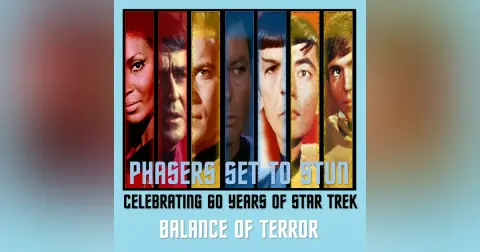
Chuck Bryan of the Cinematic Flashback Podcast beams aboard to join Wayne on the bridge for a spotlight episode. Our celebration of Star Trek's 60th anniversary continues with Balance of Terror!
Watch us on our YouTube Channel and subscribe now!
Head over to our Patreon and get started with a FREE 7-day trial. We've got plenty of exclusive content and episodes that you'll only find there! You can also sign up as a free member!
Wayne's Star Trek book reviews can be found here!
Hop into the Wayback Machine with Chuck and Matt on the Cinematic Flashback Podcast!
Write to us at A Film By... Podcast with your questions, and comments about the show. You can find our full library of content, access to our social media, and links to all of your favorite streaming platforms!
0:01 Space, the final frontier. Join us for a bold conversation. Our prime directive, to recap our favorite Star Trek shows, both new and old. To engage in debate about all things Trek. Prepare to energize. With phasers set to stun. Welcome back to an all-new episode of Phasers Set to Stun, where we continue to show our love for everything Star Trek in this ongoing series from a film by podcast, which focuses on every system of the expanding Star Trek universe by covering television, movies, animation, directors, merchandise, and and much, much more. We are continuing to celebrate the 60th anniversary of our favorite series by going into the Trek back to the 60s and taking a closer look at each episode of Star Trek, the original series, in their canonical order.
1:13 Plotting your course on this voyage is a third of your Trek crew. I'm Wayne Whited, your host on this voyage of the Starship Enterprise. Both David and Scott are away at this time. They say they're on secret missions for Starfleet, but I suspect they're just lounging on a beach on Ryza, displaying their hornga. However, I am not alone on the bridge today, because I have a special guest here on loan from the USS Yorktown and host of the Cinematic Flashback podcast, and that is Chuck Bryan. Welcome. Wow. I cannot believe that I am back here on the bridge. I mean, it's just... just closing my eyes and just hearing the sound of the bridge going. It's just, it's so warm. I, oh, wow. Yeah.
1:59 The first time we had you on phasers, we talked about a Star Trek first contact. Then we had you back for our discussion on a Star Trek, the motion picture. And now we're here talking about the original series. Well, we seem to be moving backwards. Well, look, I mean, I, the original series is, I mean, that's my, that's what I grew up on. That's my bread and butter. And no matter what Star Trek series comes out now, I'm always comparing it back to TOS. Oh, yeah, me too. Yeah, I mean, you know, I've seen these episodes all the way back in the 80s, although it's really nice watching them again, reminding myself, because some of them I haven't seen in probably like two decades or so. This happens to be one of them.
2:43 Yeah, well, these are always good to go back and watch and rediscover. Some of them have aged wonderfully. Some of them, maybe they played better when I was younger. But I still have fun with them. By now, most of you probably have already seen this 60-year-old episode, either by its original airing or its syndicated reruns over the years or streaming on Paramount +. Therefore, I won't call a spoiler alert this time. So you seasoned Trekkers out there, just sit back and relax and enjoy our banter as we look at which episodes stand the test of time and remain important in the Trek scheme of things. Today is a spotlight episode where we center our discussion on just one important episode, and that one is Balance of Terror. That's written by Paul Schneider and directed by Vincent McEvity and originally aired on December 15th, 1966.
3:40 Let me give you a short summary of the episode. The USS Enterprise, commanded by Captain Kirk, investigates the destruction of of Earth outposts near the Romulan neutral zone and discovers that the attacker is a Romulan vessel equipped with a cloaking device and powerful weapons. As the Enterprise engages the enemy in a deadly game of cat and mouse, Lieutenant Stiles, whose family suffered losses in the Earth-Romulan war, questions the loyalty of the half-Vulcan Mr. Spock. After surviving a devastating attack, Kirk attempts to lure the Romulan ship into a trap but the malfunction forces Spock to rescue Stiles and fire the phasers, critically damaging the enemy vessel. The Romulan commander refuses Kirk's offer to rescue his crew and destroys his own ship. While Kirk is left to comfort Ensign Martine after her fiancé, Lieutenant Tomlinson, becomes the Enterprise's only fatality. So, you know, it's... This is a big episode for the first season of the original series, hugely important in the continuity of Star Trek and Holes. We got the debut of the first big baddies of the series, the Romulans.
4:48 That's right. What are your first thoughts on this episode? You know, okay, first of all, the writing for this, where they introduce an entire race of the baddies. They introduce the Romulans. They throw out Romulus and Remus. They introduced that there was a war that had happened 100 years ago that ended up with this neutral zone between the two spaces with outposts guarding and to make sure that each side abides by the terms of the treaty. I mean, you're given a lot of information in a very, very small amount of time. And I kind of found myself like my head was spinning just a little bit because...
5:36 I'm trying to think of if I was there on the original air date, how much of this information could I take in? Because today I have all of the, the, the knowledge that I have. So, you know, a lot happens. That was my initial thought was just how much information we learned quickly about the Romulans. There's a lot. I mean, you don't, I also tried to rethink about, you know, what it must've been like watching this and probably I would have would not pay attention to any of that stuff. But now, you know, looking back 60 years later, how important it's, you know, there's stuff that I forgot that they introduced here. Like you said, the, the whole twin planet, Romulus and Remus, you know, that, that actually surprised me that that was actually, you know, mentioned here in this episode. But, and these are, these aren't just your, your normal enemies. I hesitate to call them enemies, but I guess at the time they were, because, you know, these are, very developed race. The writer did a fantastic job at creating the Romulans and their culture, their technology, everything. It's just, it's unbelievable. It's so imaginative and, and for very early in the series too. So, which is, I guess that's exactly what it needed. I mean, it's so much continuity created right here in this 45 minute episode.
6:55 And they, they also deal. I mean, I, I did not remember Lieutenant Stiles in this episode. Yeah, I didn't either. I forgot all about the whole wedding thing and him and his wife. Yeah, completely. Well, Stiles, you know, being the navigator on the bridge who his family had history with the Romulans from the First War, you know, he's bringing this prejudice forward, which if you think about the time in which this was aired, I'm sure that people could relate to that from some of You know, the U.S. 's previous wars, you know, in the World War II with the Germans and the Japanese. But, I mean, that's for a wagon train to the stars, that's pretty heady material right there. Yeah. Oh, yeah.
7:47 I mean, that basically moves it in from, you know, the typical Western in space that they were doing. This is more like a war movie. Oh, yeah. It's very obvious what they're trying to emulate. This is, you know, it's submarine battle is what it is. It's very obvious, but it works. I mean, spaceships are not much different than a submarine, really. There is one little bit that I'll talk about later that didn't work for me. But I just I love this. I think this is one of my probably one of my favorite episodes of the first season. It's definitely one of the strongest, in my opinion. Yeah, it's it's tense. It's suspenseful. just like a good war film. They didn't have a big budget to work with, but it seems they were able to get some really nice visual effects in it and a lot of really good acting and a lot of good directing to make it all work.
8:41 It's just a phenomenal episode. It's one of those episodes you can't skip. You have to watch this one. The submarine battle, like the destroyer following the submarine you know and the submarine has uh maybe a more powerful weapon but it's weaker and in order to fire the weapon it has to remove one of its uh offensive you know cloaking technology oh my gosh we we introduced the cloaking device right in star trek at this point so i mean if you think about it the cloaking is kind of like i i would imagine like the Submarine being under the sea and the sea being the cloak, if you will. That was the cloak in space. So they introduced so much in here. And I have a lot more to say about the submarine references.
9:31 Yeah, I mean, you know, you're right about the cloaking device. It's created basically so that the characters, the Enterprise characters, and Kirk specifically, that, you know, he has to use his instincts directly. They have to use their instruments. They can't use their eyes, just like a submarine battle. I mean, that's exactly what they're trying to do. And you know, what an ingenious thing that would continue to be used in Star Trek so much. And so much that they'd have to create reasons for why the Federation ships don't have them. Right, right. And, gosh, we see a different Kirk here. Normally, Kirk is the explorer. Kirk is the adventurer. And in this one, we're seeing Kirk as a very reflective commander, you know, going into battle against a surprisingly almost an equal on the other side. You know, because this is also the introduction of Mark Leonard.
10:40 Yeah, that's right. Into the Star Trek universe. Yeah. I mean, we learn a lot about Kirk. as a captain in this episode, just, just watching him, you know, you're right. He's dealing, he's met his match. He's, he's dealing with an enemy, an enemy captain that is just as clever and as resourceful as he is. And, you know, he, he's having to, to think beyond, try to stay several steps ahead of, of this Romulan commander, just, just to keep the enterprise alive. You know, he has to weigh his option and he has to figure out where to attack, when to hold back. It's, it's wonderful. character development for Kirk, you know, he's, he's been great for the, for this second half. This is, we're now in the second half of the first season, but he's been great for the last 13 episodes. But this episode really, we really see Kirk as why he's the best captain in Starfleet.
11:31 Yeah. Yeah. I mean, when you, when you say that this is a, a spotlight episode, you know, that if somebody is, you know, what, what are you going to have them watch? I mean, you know, I think, I think you could, you could pull this one out. You could pull out City on the Edge of Forever. These are just great, great episodes all on their own. And I think that this one is great because it's science fiction, but it pulls from stories that we're familiar with. And people even during that time would have been familiar with. Maybe more so with the submarine warfare movie because, you know, that was, you know, you had like the enemy below.
12:14 You had run silent, run deep. And, I mean, these are just all films that people would have known about and could have related this episode directly to. Yeah, I mean, we chose this as a spotlight episode not just because it's chock full of continuity and important to Star Trek. But this is one of those episodes that people remember. that have been talked about over years, over years, ever since it was first airing. It's always been brought up. There have been sequels written about it. There have been prequels written about it. You know, it's just one of those very memorable episodes. And I wanted to single this one out because it deserved more attention than what we have been given to the other episodes.
12:55 Didn't Strange New Worlds kind of do a pickup on this in season one? Like, oh gosh, it was... Yeah, yeah. Season one finale was like a quality of mercy. Yeah, it was their finale, yes, and it was wonderfully done. That's probably my favorite episode of the first season. Yeah. Coincidentally. Oh, yeah, that was a great episode. Yeah. And it's a great episode to watch afterâ if you guysâ if there's anyone out there that hasn't seen this episode, I know there's probably not very many, but Scott, I could just be talking to you. You might be the only one. But if you watch this episode and then watch Quality of Mercy after this one because it's great.
13:36 They're great opposites because here we see how Kirk dealt with it and then the episode we see how Pike would have dealt with it and it came out disastrous. They're great episodes and it makes a goodâ it's not exactly a sequel. It's not exactly a prequel. It's more of a side alternate version. Yeah. Yeah. I mean, it's, it's, it's, it's a good episode altogether, both of them. So they're, they're, they're, I think they compliment each other very, very well. I think so too. Yeah. I think the introduction of the Romulans is another reason why, you know, this episode works so well. Um, you know, there's, there's a lot of history being told here. You touched a little bit on it up there, you know, being this big war a hundred years before, which we finally saw 30 years later, a little bit in enterprise, but, um, It makes this episode, meeting them for the first time, a genuinely important moment in the history of Star Trek.
14:35 Yeah. And the whole revelation that they're related in somewhat as the Vulcan makes kind of interesting, an interesting twist to it. Yes. And really makes you want to know what the heck's going on, what's more about it, which you don't get in this episode. You have to wait a long time to find out about that. But, um, and then also you mentioned, you know, Mark Leonard, he's terrific. I think he's, he's phenomenal. He's not just, not just as mindless villain, you know, that some writers could have brought in that just that wants to destroy the enterprise or take it over. He's intelligent. He's disciplined. He clearly understands, you know, the position he's in with his ship and with going up against Kirk. Um, there's a lot of mutual respect between the two characters, um, it makes that exchange at the end, you know, just more powerful when it comes to it. Because you get, you get the feeling that, you know, under, under different circumstances, they probably could have been, would have been very good friends.
15:34 Most definitely. And I think we said earlier that, you know, we see Mark Leonard, he goes on to play Sarek Spock's father. He goes on to play the Klingon commander in Star Trek, the motion picture. You know, I completely forgot about that until I did the research. I totally forgot that he was a Klingon. But see, it's easy, right? Because when you see Leonard here as the Romulan commander, and of course he's purposefully looking like a Vulcan, maybe a little bit more heavier makeup in some aspects, but you could honestly believe that if the Romulans were, you know, kind of the offshoot of the Vulcans when, with that never embraced logic and maintain their more militant, uh, uh, attributes, um, maybe this is a long lost brother of Sarek that, you know, they never speak, they never speak about, you.
16:32 Know, it could be, yeah, that would be that way. You know, that'd be an interesting twist. I want, it makes me wonder, I want to do a little more research if they, if anyone has ever touched on that, and maybe it's one of the novels or complex or something. Cause I'm, can't believe that no one would have because that would make a really interesting story. It's it's right there yeah one of the things that i picked up on this on this viewing was how much that the romulan commander he wanted to get back to his side of the neutral zone and you know he was afraid that they would never see their stars again and and then there was the the other centurion who was just kind of prodding him you know no no you know keep going Someone who is definitely a little bit more, I guess, politically minded in their society.
17:18 And then you had the other guy, the centurion. I think he was maybe played by John Warburton. He was the older centurion. To me, yeah, and he was the one who meets his demise in one of the encounters. John Warburton kind of reminded me of like he was Romulan commander's Dr. McCoy. You know, kind of that someone who's there to be a sounding board and to, you know, he can't carry the burden of command, but he's providing advice much in the same way that we see McCoy later in this episode doing the same thing for Kirk as Kirk is now, you know, he realizes that he's putting the crew of the Enterprise in danger. And he realizes that that they can sacrifice the Enterprise, they can sacrifice the outpost if it doesn't escalate into war. But he will do what he needs to do, but he still questions himself whether or not he's doing the right thing. And that's a Captain Kirk that, you know, when we think about Kirk, we always think about, you know, risk. Risk is our business.
18:36 You know, the guy who's going to slingshot his bird of prey around the sun to travel back in time to pick up two humpback whales so that he can get back and tell this probe what to do with itself. But the Kirk who is honestly going, am I doing the right thing? You know, I thought that was a very, I said, you're seeing a more military forward Kirk in here. And this in and of itself is surprising, you know, because Gene Roddenberry is, didn't want, you know, the Federation to represent, you know, a, a military, right?
19:18 Yeah. But that's hard to do. I could, I mean, I, I know he was trying to do the wagon train to the, to the stars and, and didn't want that. But when you have ships like this, that's really hard to do to avoid that. I mean, it's, it's definitely, there's no doubt that star fleet is military. Um, right. They've, they've have been since day one, really, despite the fact that they didn't want that. But, And I'm glad they didn't goâ they went this way because it works much better when they when they, well, well, but see. There's, there's, there is the, there is the idea of being warlike, but then there's also the idea of, but we will defend ourselves. We will, we will take action.
19:58 And this was, uh, one of the, one of the, one of the episodes where you actually see that happen. And, uh, yeah, that was good. Yeah. Cause I mean, if you think about it, If you're explorers, if we start going out there to the stars, exploring, building ships like this, not everybody is going to be our friends. We would love to think that, but it's not going to happen. It doesn't happen on this world. It won't probably happen on other worlds. We were thinking the same thing. So you're going to run into a race or an area of space that's going to be hostile to you. And you don't want to start a war with them, but you will defend yourself and your territory if they come at you. I like that. I like that part.
20:46 I like that idea of Starfleet that, you know, hey, we want to make peace, but, you know, you attack us, we're going to defend ourselves. Yeah, yeah. You know, one of the interesting aspects of the previous Hundred Year War and, you know, all the way through the, I guess, the peace treaty with the neutral zone, it was established that due to the, I guess the technology of what they had at the time that neither side had ever seen each other. So nobody, the Romulans didn't know what humans look like. And, you know, the Federation didn't know what Romulans look like. And then there's that reveal of what I found to be like the weakest part. When they get the signal and then they can see inside their bridge, I always kind of felt, eh, that's a little contrived. But, the reveal. Okay. And we've talked about this is that to everybody on the bridge, it looks like they're Vulcans. I mean, gosh, that had to be for Mr. Spock. That, that had to be a, an awkward moment when you realize everyone on the bridge is like, Hey. Yeah.
21:57 Cause you know what they're thinking. I mean, we're thinking it too. Or when we, you know, for this episode, I understand Lieutenant Stiles is a, reactions to it because it makes sense i mean you know i just i find it so weird that that they fought a big war and and never once ever saw the face of their enemies i think i i know i find it weird but i also find it very intriguing and it's been a while since i saw enterprise makes me wonder if they if the continuity has stuck with that over and all their appearances I've got to go back and see those. Yeah. That would make it really difficult to show the Romulans. It was funny. I was starting to watch Enterprise on one of the streaming services. I think it might have been like Tubi or one of the other ones. And I had the volume down because I was just running it on my TV screen while I was working. And I would look up and I think I was kind of at the end. You know, with the Andorians and stuff.
22:57 And I'm like, oh, I started kind of getting into it. And I was like, hey, I want to go back and rewatch this again. Because, honestly, I've forgotten quite a bit about Enterprise. I forgot that they had that Romulan plot. Yeah, I've forgotten a lot, too. I know we're going to go and we'll do the top ten in the future. So I've been kind of saving it until I do that. Remind myself when I watch those. But I think we're still a ways off for that one. Yeah, yeah. You know, there was an interesting tactic that the Romulan commander used. You know, I said that one of his confidants, you know, he meets his demise. And so while they're still cloaked, they release wreckage or debris, including the body of that centurion, right? And, of course, Spock is looking at it, and he's kind of going, well, there's a body, but there's just not enough mass. To represent what an entire destroyed ship would be like. So he kind of figures that this is a trick. That same trick, though, was used in a movie I mentioned earlier called Run Silent, Run Deep. Okay. Run Silent, Run Deep was directed by Robert Wise. Oh. Who directed Star Trek, the motion picture.
24:20 There you go. Yeah, you know, I've heard of the film. But I've never seen it. And after doing the research, after hearing you talk about it, I really would like to watch it because I love Robert Wise's work. I always have. And I've seen most of his films, but that one's kind of slipped by me. Yeah, I haven't seen The Enemy Below, which they accredit that film influencing this particular episode. So I didn't know anything about that. But I did pick up on the Run Silent, Run Deep. I've seen that. I think you would enjoy it. And again, it's Robert Wise. Oh, I love a good war film. Oh, yeah. Whether it's in the air, land, or sea, I love a good war film. I know I enjoy it.
25:03 Oh, well, the thing is I like the submarine warfare movies, whether it's from the old black and whites or we're doing Hunt for Red October. And I think that was, what, U-571 at one point. I love those episodes. So when you see in this episode, the Enterprise is firing the phasers in a proximity burst. OK, I don't know what that means, but apparently it's like a depth charge. The Romulan ship reacts the same way. And and I'm not sure. But was it did they use the same? They didn't use the same sound effect with it or not. I.
25:48 Well, let's talk about that. I have that in the Trek trivia, but I'm going to move that up because this is the one thing that I thought was just so confusing for me. What is up with their firing procedures and stuff? I mean, that seems to be the most inefficient system I've ever seen. I know what they're trying to do, but on the Enterprise, it just doesn't work. Instead of people just pushing the button... On the bridge, they have to call down to another room so that someone else down there can push the button. It just seems like that delay that would cost anyone their lives in an actual battle. And the sound effects were wrong.
26:32 They hadn't created the photon torpedoes yet on the show. So they're using the phasers, but they're using the sound effects for the photon torpedoes. That's... That's what it was. Okay. Thank you. If they had created the photon torpedoes and said that, it would have made complete sense. The whole thing would have worked. Right. But why are we having someone else in a completely different room fire the phasers? That bothered me. I don't understand that. I'm glad they stopped doing that. Yeah. Well, at some point they said, you know. let's say that we got rid of the phaser control room that has this potential for phaser coolant leak to happen.
27:13 Let's just hardwire it straight in. And if, you know, there's a system issue, we'll send a guy in a white jumpsuit down there to fix it, you know? Yeah. Yeah. I mean, with photon torpedoes, you have to have people, you know, you have to have people load them. We saw that, you know, in Star Trek 2, you know, we saw the photon torpedo room. So that makes sense. If they have been able to use that, if they had created the photon torpedoes a few episodes early than they could have done that. No problem. It made sense completely, but phasers now that just, you just push a button and you know, there it goes. There you go. There you go. And it seemed like to me that, that there was a lot of things that would go, that could go wrong. And they, they use the phasers. Like they sometimes will use transporters, like the transporter not working right. You know, that becomes kind of like their, their, their thing for the episode. And in this one, the phasers kept going on the fritz, you know? So, and so, uh, finally kind of culminating with, um, styles having to go down and help out in phaser control, uh, room to resolve the, uh, that's that little thread of the episode.
28:19 Yeah. In my own mental continuity, the enterprise went back and had a little bit of a reef. They fixed that for the next episode. So I hope so. I definitely hope so. That definitely was a, um, I don't know. I agree with you on this though. Now, what'd you think of the ending of this episode? The whole, uh, the whole sacrifice and then the, uh, the death scene. Oh, you know, that's the thing that I, I wish that this episode would have been 90. Well, like a 90 minute episode, right? Because I would have, I would have liked, um, I don't know. I felt like it wrapped up so fast and maybe not a 90 minute, but maybe like a, an hour and five minutes or something.
29:06 It just felt like that, that once the episode started to wrap up, everything happened very, very fast. It did. It did. You know, and, and I, I felt the, you know, it was a, it was a victory, but the victory didn't come without some cost. Right. And, and it was kind of sad because the, you know, the show opens up, Now, with Mr. Scott giving away this ensign as as as the bride to Lieutenant Tomlinson. And then, as you said, at the top of the of the hour. Tomlinson becomes the only casualty. And it ends with Kirk, you know, comforting her in her grief. And it just, I mean, that just seemed to really wrap up really, really fast. But, you know, that was, I mean, that was just the bookend of the story that kind of helped. show the, the consequence of, of, you know, going into battle, like there there's, there's cost. And in this case, uh, it was our, um, our phaser control ensign who, uh, who, who, who, who lost out on, on her, uh, who, who lost her, her love.
30:17 Yeah, you're right. I felt the same way that This episode probably could have benefited with maybe another 10 minutes, 15 minutes, too. Because I really like what they're doing at the end. It just felt a little fast. We needed to stop and focus and kind of think about what had happened. They won the battle, but it really, on a personal level, there's really no sense of triumph there. at the end because of that loss. Um, and then having to try to comfort, you know, the, the, the grieving, uh, well, you know, uh, what was his name? Um, Martin. Yeah.
30:58 His wife, uh, you know, that I think could have deserved a few little, few more minutes at least, um, with the crew after the battle. But, uh, you know, all together, I, I'm going to look past that cause it's, it's a, It's a great episode. It's one of my favorites, as I said. It's suspenseful. It's very intelligent. The writer did a phenomenal job at this and world building. It's an emotional episode. Exactly what, in my opinion, this is what makes Star Trek special. This is a special moment in Star Trek history. Yeah, this is, if they ever wanted to, if they were ever wanting to make a movie that had kind of the excitement of wrath of con, you know, something, something like this film. And I, I, this episode, I don't know how they could like, you know, supersize it without, you know, you know, reduplicating it, but bringing in the amount of depth and attention. And, uh, I mean, it plays just like a submarine movie all the way down to the, you know, the enterprise is turning off all the lights and everybody's getting real quiet and talking and hushed tones. And they're just, They're waiting each other out.
32:11 It's a lot of suspense. They did great. And you're right. The opening five or ten minutes, you get so much world building that is so succinctly told. And if you're not keeping up with the dialogue, up on the bridge, they put a graphic of where they are. And that graphic Now, not the exact graphic, but almost a very similar graphic showed up in the Strange New Worlds episode. So I started re-watching that this morning, and I saw the graphic up there, and I'm like, yep, they're consistent.
32:54 Yeah, I don't remember what episode that was, but I know which one you're talking about. There were some changes and stuff, but I recognized it right away. Oh, yeah. Well, the outposts weren't, what, two miles deep? But, yeah. So, it was good what I saw of it. But, yeah, no, speaking of balance of terror, we got the Romulan bird of prey. So, we had the first of the bird of prey ships. I forgot to even mention that. That's right. ultimately harvest more than just cloaking technology from them in the future.
33:37 And their design of the ship, which is a beautiful ship, and it was rare for the original series to actually create a new ship. It wasn't the Enterprise, but it's a nice ship. But it also makes me wonder where they got their ideas, because there's a lot of similarities to the Federation ships, and it makes me wonder that maybe they took some inspiration from the wars. from the Federation and updated their ships. And, you know, like there's a little bit more story between the lines there. That I wanted to hear about. Yeah, to me, it seems interesting how just even, and I understand that there's a production design, right? But if we were to ignore that that's intentional, you know, I just love that the races all sort of kind of come up with, very similar placements of engines and stuff like that. You don't get like the, like in the movies and some of the movies you get more exotic designs and, and, and definitely in discovery, we start to get extremely exotic ship designs. Um, but you know, for, for where we are in 1960 on a budget that I mean, gosh, I think, I think I read somewhere that maybe this was, It was one of the earlier shows that they filmed, but it didn't get released because of the amount of effects that they had to do on this. And so that's why it was released later.
35:05 We talked about that on our last episode, that because of the time that was needed to do this episode, that's the reason why we got the menagerie. Oh, okay. Because we were able to use the footage they already had, save money, and save time. Time was actually more important than money for them because they needed more time to finish this episode, though. Yeah, definitely. All right. So why don't we take a short break and then we'll be back to talk more on Balance of Terror. So now that we've given our opinions on the episode, let's take a look at the characters themselves. Which character do you think shines the most in this episode, Chuck?
35:46 You know, there's a lot of characters to choose from. on here and, uh, I'm, I'm not going to give the answer where I say one character and then kind of give you three or four more reasons why the other one should be there because Jeff told me not to do that. We do that all the time. But, um, but you know what? I, I am definitely, I'm just going to go ahead and choose the Romulan commander played by Mark Leonard. Um, because this character is, Could have been more like. But instead. They chose to make him. And Leonard played him excellently. As being this dignified. Intelligent. Complex.
36:34 And ultimately. They made him. A very sympathetic enemy. As his mesh. As you know. As the episode concludes. So I felt for. The enemy of the week. they made him very deep and broad. And I don't see that all the time. He wasn't cardboard. And I have to believe that that's one of the reasons why they brought Mark back for more Star Trek. Yep, I agree. But I actually, I chose Spock. I wanted to choose Kirk, but I chose Spock because I really like, in the episode how he deals with Lieutenant Stiles, you know, the questioning, questioning his loyalty because he's, you know, half Vulcan. You can understand why Stiles is thinking about that, why he has the strong feelings about the Romulans, considering what happened to his family and the war. But, you know, Spock doesn't let that get to him. He keeps doing his job. He keeps offering Kirk good advice, helping the Enterprise figure out how to deal with that enemy. Um, I also like the way that Spock doesn't feel the need to prove himself to Stiles because, you know, he knows where his loyalties lie. He knows he's letting his actions speak for him, you know, rather than having to argue with the lieutenant. But the moment that really stands out for me is when you mentioned earlier when Spock goes to rescue Stiles after the coolant leak takes around
38:05 in the phaser room. Here's a guy that's been questioning Spock's loyalty all through the whole episode, but yet Spock still put himself in danger and saved his life. You know, then he steps in and he fires the phasers and helps Kirk, uh, turn the battle around. So that's what makes Spock a great character, right? Yeah. That's that scene alone right there is one of the best things I love about Spock. You know, he doesn't get into an argument and he doesn't try to get even. He just does what he needs to be doing. It's the logical thing to do. Um, he proves himself and proves how great of a Vulcan proves a great, how great of a character is. Um, Just, you know, that's why I chose him. I think it's an incredible Spock moment.
38:48 Now, that is a very good choice. And the great thing about this episode is that there are no wrong choices. When you were describing Spock, it made me remember a childhood memory that I had always thought that Vulcans were emotionless, right? And, of course, you learn later is that you know, they have emotions, but they have, they have gone through different trainings to control that because if they don't, well, you get the Romulans essentially. And then they would have probably just, you know, become a warlike and self-destructed. But, but in this case, you see Spock just exercising all of that control and even makes some very logical decisions where he, at some, at one point he agrees with Stiles and Stiles assessment, um, And so I think that your choice was perfect.
39:54 Your choice is great. Like you said, all choices are really good because there's a lot of good character moments. Even Yohura, she gets to take the navigation. I have to say, I had forgotten that. That was so good. I had too. I love the little touch of her. She switches off her own panels. before she moves over to the other one. And then she does her own job as well as the other job with that. I thought that was fantastic. I didn't realize she had a moment like that. Oh, she, this, this was a, this was, oh my gosh, this is, this is almost like that Star Trek four EPS movie where everybody has their little moment to shine, you know, all do something, you know, exactly.
40:34 Yeah. So good. So good. All right. If you have the choice to be any of the characters that appeared in this episode, which one would it be? And why I'll let you go first. Again, Oh, boy, howdy. Well, in this case, I am going to choose Captain Kirk because, you know, if you ever ask me what character I want to be, I'm always going to say Kirk. Kirk is my hero. He was my childhood hero. He was more of my hero than Luke Skywalker was. And those are the two big ones in my childhood. But what I really liked in this episode was that it was where he had to take command of the Enterprise and through a very tactical confrontation.
41:17 So we got to see a different version of Kirk, you know, and at the same time, you saw great qualities about Kirk. This wasn't something that he relished. This was something where he was reflecting on whether he was doing the right thing or not. And, you know, I just, you know, I would always hope that, you know, whatever I do, you know, I always hope that I have the integrity and just a, the resolve and the command and the lead that he was showing in this particular episode, you know, and at the very end, he offers to help the Romulan commander that they don't have to go down with the ship. They can beam them over, but you know, unfortunately that was not their way. So I would pick Kirk.
42:04 I did too. For almost the same reasons, you know, it's, He's got a great, he's got a lot of character development, but his storyline is so interesting. The responsibility that he has, you know, he's not just trying to save his own life. He's responsible for everyone aboard the Enterprise. He has to keep his own emotions under control, you know, when things are going terribly wrong. And that's very difficult. He's not a Vulcan. He's got to struggle with that and with indecision and doubt. I think the final conversation that he has with the Romulan commander would be, you know, just was absolutely fascinating and be a fascinating thing to experience.
42:46 Cause you know, he realized that, um, you know, the, the commander was not much different from, from him. There's a lot of mutual respect, uh, even though they're on opposite sides. Um, of course, you know, I wouldn't exactly enjoy having a cloaked Romulan ship trying to blow me out of space, but you know, if I had to choose to be somewhat, it would Kirk would be my pick because like you said, it'd be exciting to command a starship in situations like this, you know, the challenge of outsmarting a worthy opponent and making the decisions that determines the fate of your ship and the entire crew. I mean, it sounds terrible, but it also sounds incredibly intriguing and fascinating to me.
43:27 Yeah, definitely. I love how Kirk also, you notice Kirk a lot of times like you, you, you think, and Star Trek does this all the time and it's, it's really great. Um, that the, the, the captain is not the person who says it's my way or the highway. He seeks advice from his senior officers. He reflects on what he's doing. And, you know, it's, it's not something that he relishes going into battle, but if they're going to do it, they're going to do it and he's going to take the responsibility for that. And so, you know, even breaching the neutral zone, you know, he was, he would, you know, this is, I can't contact Starfleet, but I'm going to, I'm going to do this. Yeah.
44:19 And now we go to our favorite part of watching these episodes, the Trek trivia, where we dive deep into the episodes and their production and and enlighten you with some interesting facts. Was there any interesting facts? And I know there's a lot of them in this episode that you'd like to share with us. I'm trying to think of ones I haven't really said already. But did we mention on air that this was... the score was written by Fred Steiner? Yes, and he's... he's not just incredible in Star Trek, his scores, but he's an incredible composer outside, too. I love his work here on Star Trek. The score is phenomenal. You know, what's always... or what I found very cool about learning about Star Trek and the music of Star Trek is that everybody knows Sandy Courage. They all know Alexander Courage's themes, the main theme, and some of the other motifs that come up. But it was actually Fred Steiner who wrote a majority of the music for season one that they would go back and they wouldâ Some of the episodes had no original scoring and they just took the tracks from other ones and the editors were phenomenal to be able to edit them together.
45:33 And this was one of those episodes they did that a lot with. They took a lot of this music. So it's music that's kind of ingrained in our memory from watching a lot of the episodes. And I didn't realize, I always, for years, I always thought this was Alexander Courage's music. I knew he did the theme, but no. I love Courageous music, don't get me wrong. I think he is also a phenomenal composer here in Star Trek and outside. But some of the most memorable music, some of the episodes that the music sticks in your head were composed by other composers. This episode, like Mock Time is another one that's done. Trouble with Tribbles, all of those were done by fantastic composers. And it's music that I remember. I can still hum even when I'm not watching episodes.
46:25 . . You know what? I will tell you something. This episode was the first episode released with the new CGI effects. Oh, yeah. I remember when they first brought those out because I was so excited that they were airing them on television week after week. But I didn't realize this was the first one. Yeah, this was the first one. I read that. And I watched the CGI version of it. this time i have the the the disc where you can choose either either episode on it and i watched it and i have to say that you know they've been out for a while now and i'm starting to believe that i enjoy the original effects a little bit better maybe it's just the old school in me but that's not really trivia but.
47:38 That's just i understand what you're thinking too i'm I'm about 50-50 when it comes to that. I loved them back when they were first airing, which was, well, I guess it would be about 20 years ago because I think they did it for the, what was it, the 40th anniversary. I thought that was so cool that they were doing this and they were airing it. But now watching them again, some of them work. Some of the episodes are working. I'm glad that they redid them, especially when they take the little lighty blobs that would fly around space and actually give them chips. I like them when they do that. But other times... I'm like, well, the original original visual effects were were fantastic. Let's just stick with those. And this is one of those episodes actually where I say that I think the original episodes visual effects are great. They're they're 60. Yes, definitely 1960s visual effects, but they work. They really work because they're technically kind of minimal in this episode.
48:29 Yeah. Yeah. Really important to the story. So, yeah, I agree with you on that. But at least on the disc that I have, you have the option. And as long as I have an option, I appreciate it. And I'm looking at you, George Lucas. Yeah. And that's good. It's a great defense for physical media because if you go and watch it on Paramount Plus or you watch the streaming services, all you get are the new effects. It's your only choice. So, yes, keep bringing those DVDs out, people, because we need those. Yeah. How about you? What were some of the tidbits that you pulled up? Well, first, I usually start talking about some of the behind the scenes and I want to start talking about the writer. I already talked about the director in a past episode, but Paul Schneider was a television and film screenwriter.
49:21 His career spanned several decades. But, of course, he directed two episodes of the original series, this one and The Squire of Gothos, which is on our next episode. Oh. But he also directed the Territon Incident, which was an episode of the Star Trek The Animated Series series. which really shows some pretty imaginative sci-fi ideas there. But outside of Star Trek, he directed for Bonanza and Mod Squad, Marcus Welby, Six Million Dollar Man, and he also did Buck Rogers in the 25th Century, which is a show I love. Yeah, Buck Rogers in the 25th Century, Gil Gerard, that is a movie that I want to review on Cinematic Flashback.
50:04 Oh, yeah, I love that movie, and I just watched it, I think it was about a year ago, because I grew up with that show. I was like, what, six or seven when that came out. And I love that film, and I still love it. Yeah, it's really good. And you know you're watching the film version of it and not the TV episode when you get that kind of James Bond opening with Princess Ardala. Oh, where she's tumbling over the logo? Yeah, yeah, and Colonel Deering. That's my favorite part. Well, it's mine, too. I'm sorry. Go ahead. No, it's like I totally interrupted you on Buck Rogers talking about the writer.
50:48 I always will talk about Buck Rogers, but we are talking about Star Trek. I know. I know. I'm sorry. We also mentioned Mark Leonard. You know, he played Spock and so he played Sarek, Spock's father. And so many other, other things. Star Trek three, Star Trek four, Star Trek six, which I completely forgot he was in it. I need to go back and read. He was in the animated series episode yesteryear and two episodes of the next generation, Sarah communication. Um, he also was on Buck Rogers in the 25th century, but he did a lot of other stuff. He was an incredible Hulk Y five Oh, and he played, uh, Charles Ingalls' older brother Peter in Little House on the Prairie, too, so he's very prominent in 60s and 70s TV shows.
51:37 You can't miss his face. It's very recognizable. Yeah. I have to let Dirk Smith know to look out for Mark Leonard as he's doing his reviews of Little House on the Prairie with his wife. Oh, is he reviewing it? That's another show that. I always liked that show growing up. My grandma loved that. So we watched, of course, but I don't remember him on there. And now that I know that he's been on it, I'm kind of curious to go back and watch a couple episodes with him in it. Cause I love his, his acting. He's a fantastic actor. Well, well, the more you watch of this era of television, uh, and you go back, our movies and whatnot, and you go back and you start to see these actors and you plot them. Then you might not have noticed it when you were younger, but now when you go back and you see it, you're like, Oh, you know, there's, there's a, There's Mark Leonard in this episode.
52:29 Now, you'll notice that other than Mark Leonard, the rest of the Romulans are wearing helmets that cover most of their heads. This was to prevent having to create so many pointy ears for everyone and save time and money on makeup. And that's the only reason why they have them. Brilliant. That is brilliant. I didn't even think about that. Oh. Also, the words that Kirk says during the wedding would be repeated almost exactly by Captain Jean-Luc Picard during the wedding of Miles O'Brien and Keiko in the Next Generation episode, Data's Day. So it must be something of tradition of starship captains. Sure. When they do weddings. You mentioned earlier in this, but I wanted to point out that this episode introduces the name of the Romulan homeworld, Romulus, as well as its neighboring planet, Remus. We see Romulus quite a lot in the various TV shows, but we don't see Remus until one time in that Star Trek Nemesis, 35 years after this episode.
53:27 That's right. And I want to bring this up, too. We've mentioned a lot of stuff, but I want to point it out for everybody. There's the alternate timeline version of the events of this episode in that Strange New Worlds first season finale, Quality of Mercy. That's where Captain Pike remains captain of the Enterprise and Kirk is present as the captain of the USS Farragut. You know, it's really worth checking out. I cannot recommend that enough. But I also want to mention that there is a prequel to this episode. I'm very familiar with it. So if you'd like to see the events that lead up to Balance and Terror shown from the Romulan's point of view, then you need to check out the IDW comic book Star Trek Spotlight, The Romulans. which was published back in 2008 and is both written and drawn by one of the greatest comic legends ever and my personal favorite artist and inspiration for my own work, John Byrne. Oh, man.
54:24 Love John Byrne. You know, I sleep on IDW Comics all the time and stuff, but the ones I have, they're just so good. I missed that one, but I need to see how I canâ find. That yeah they've done some very great good stuff over the years um you know some of it some of it is hits some of its myths but there are some really good stuff and this is one of them burn he loves star trek and he's done quite a few of their their series and it's all worth checking out but this this this issue phenomenal if you like this episode you should check out this issue it's easy to find you can find it on every comic. Book store was it was it like a one shot or.
55:05 It was a one-shot. Well, it was a series that they called Star Trek Spotlight. They would do a one-shot, one issue of the Romulans, one issue Klingons, one issue Ferengi. Okay. And each had different writers and artists on each one of them. Okay. I guess Byrne, he wanted to do one about the Romulans because the original series is his favorite series. And that's it for this week's episode of Phaser Set to Stun and our look back at the continuing voyages of the original Starship Enterprise. We'd like to open a channel to our listeners and hear just what you thought about the most recent episode and the season in general. Who knows? You might even get mentioned in a future show. Of course, you can email us at afilmbypodcast at gmail.com. Find us online at afilmbypodcast.com. You can follow us on Facebook, Instagram, and X. Or if you're looking for exclusive content or swag, you can join our Patreon. Find out the incredible gems that are hidden within. And of course, you didn't know.
56:01 a film by and phaser set to center on YouTube as well. You can find many of our episodes with new and old on our channel at a film by podcast. Also go to our website site and click on the articles tab at the top of the page. You can find our phaser set to sun book reviews where I'm going through each star Trek novel, old and new and telling you which ones to pick up and which ones should beam back into space. There should be a new one up on the website soon. If I can ever get our producer to put it up there, but, So please go check that out and let me know what you think about the books that we review and which ones are your favorite. I'm currently rereading the Next Generation novel Imzadi for an upcoming review, which I'm really looking forward to doing that one. We'll be switching over to the Next Generation very, very, very soon. Thank you so much, Chuck, for joining me and the listeners for another fascinating discussion.
56:48 Any interesting things coming up for you on the Cinematic Flashback podcast? Well, I think I know why your producer hasn't gotten that up yet, and that's because he's been hanging out with us in the Wayback Machine, and Jeff and Amanda Janik, Matt, and I have traveled back to 1978. We've been sitting over at the Monroeville Mall reviewing and talking about Dawn of the Dead, and we had such a good time that Jeff said, you know, I think I have a little bit more to say. And I'm like, Jeff, we talked for two hours. How much more do you have to say? And Amanda was game. Matt was game. So I've been holding him hostage in a mall. So if you're curious about where Peter got that lettuce that he served Fran in the movie, you might want to tune in because we talk about that a lot. Yeah.
57:52 Well, I'm really glad that you were here to take the place of my two small shipmates. I think I'm going to send a security down to the planet and drag them back to the bridge by phaser point if necessary. But I'm glad you're here and I'm glad we could talk about Star Trek because we talked a lot about this episode. It was really fascinating. I had fun. I love Star Trek. I have been a fan of Phaser Set to Stun ever since the first episode, and I heard the bridge noise playing. I'm like, okay, I found my new pod. We'll have to bring you a beam you over from the USS North Town a few more times. I'll be here.
58:34 Well, next time we'll be looking back at three more episodes from the second half of the first season of the original series, which will be Shore Leave, The Galileo Southern, and The Squire of Gothos. Three very interesting and very different episodes. So until then, keep watching those original episodes, and we hope to have you back here for the next episode of Phasers Set to Stun. Hey, I do appreciate it. I had a lot of fun talking about this, and these Classic Trek is just easy to talk about for me. Yeah, I'm the same way. I just can't imagine anyone that's not seen these episodes. I know there are people out there, but why? Why haven't you seen these?
59:24 You can, having never seen it and having seen all the modern Trek, go back and look at this and kind of go, okay, it looks like old Doctor Who kind of stuff, you know? Hey. Hey, I like old Doctor Who. Okay, okay. But if all you knew was David Tennant, you might not have the patience for the old stuff, you know? Yeah, that's true. But I mean, the writing, like in this episode, it's the writing, the writing, the writing, you know? And I didn't realize how minimal the effects were until you said that. I'm like, yeah, you're right.